Common Challenges When Adopting AI Tools in a Purchasing Department

"It wasn't the technology that was the stumbling block, but data readiness, change management, phased implementation, and governance."
Table of Contents
- Introduction: Why Every Purchasing Leader Is Talking About AI
- Why Purchasing Departments Are Investing in AI
- The Most Common Challenges of Adopting AI Tools
- A Step-by-Step Approach to Successful Adoption
- Real-World Case Study: A Mid-Sized Manufacturer
- Key Takeaways for Procurement Leaders
- How Gezora.ai Is Helping Industries Integrate AI
1. Introduction: Why Every Purchasing Leader Is Talking About AI
Worldwide, executives responsible for purchasing and procurement are posing the same question on social platforms and at conferences: "What are the common challenges faced while implementing AI technology in the purchasing department?" It's among the top procurement-related searches right now, and it's not hard to see why. Procurement AI is known for helping teams procure faster, identify suitable suppliers, forecast spend, and cut costs dramatically. Yet scaling up AI procurement software is genuinely difficult.
In this article, we discuss the real challenges procurement and purchasing departments face when implementing AI tools, lay out a step-by-step roadmap to solve them, provide a case study of a successful implementation, and finish by introducing companies such as Gezora.ai.
If you're the head of procurement at a manufacturer, retailer, healthcare organization, or startup, these points apply directly to you. AI procurement is not simply a technology matter; it's a matter of people, processes, and data. That's a critical distinction to understand.
2. Why Purchasing Departments Are Investing in AI
Before we look at the obstacles, let's understand why AI is gaining such rapid momentum in purchasing. Procurement teams sit on huge volumes of data: supplier contracts, invoices, purchase orders, historical spend, supplier delivery performance, and more. AI solutions for purchasing aim to convert that unstructured data into insights, detecting supplier risk, forecasting price increases, auto-approving purchase orders, and much more.
These use cases fuel adoption:
- Automated supplier risk evaluation and continuous monitoring.
- Spend analysis and category management using AI.
- Smart purchase requisition routing and approval automation.
- Demand planning to avoid stock-outs and overstocks.
- Contract analysis to detect unfavorable terms and renewal risks.
- Procurement chatbots answering policy-related queries.
This all looks good on paper, and the long-term ROI of AI in procurement is well documented in industry research. But the road from "We've bought an AI solution" to "Our purchasing team works using AI" has challenges that vendors rarely talk about.
3. The Most Common Challenges of Adopting AI Tools in a Purchasing Department
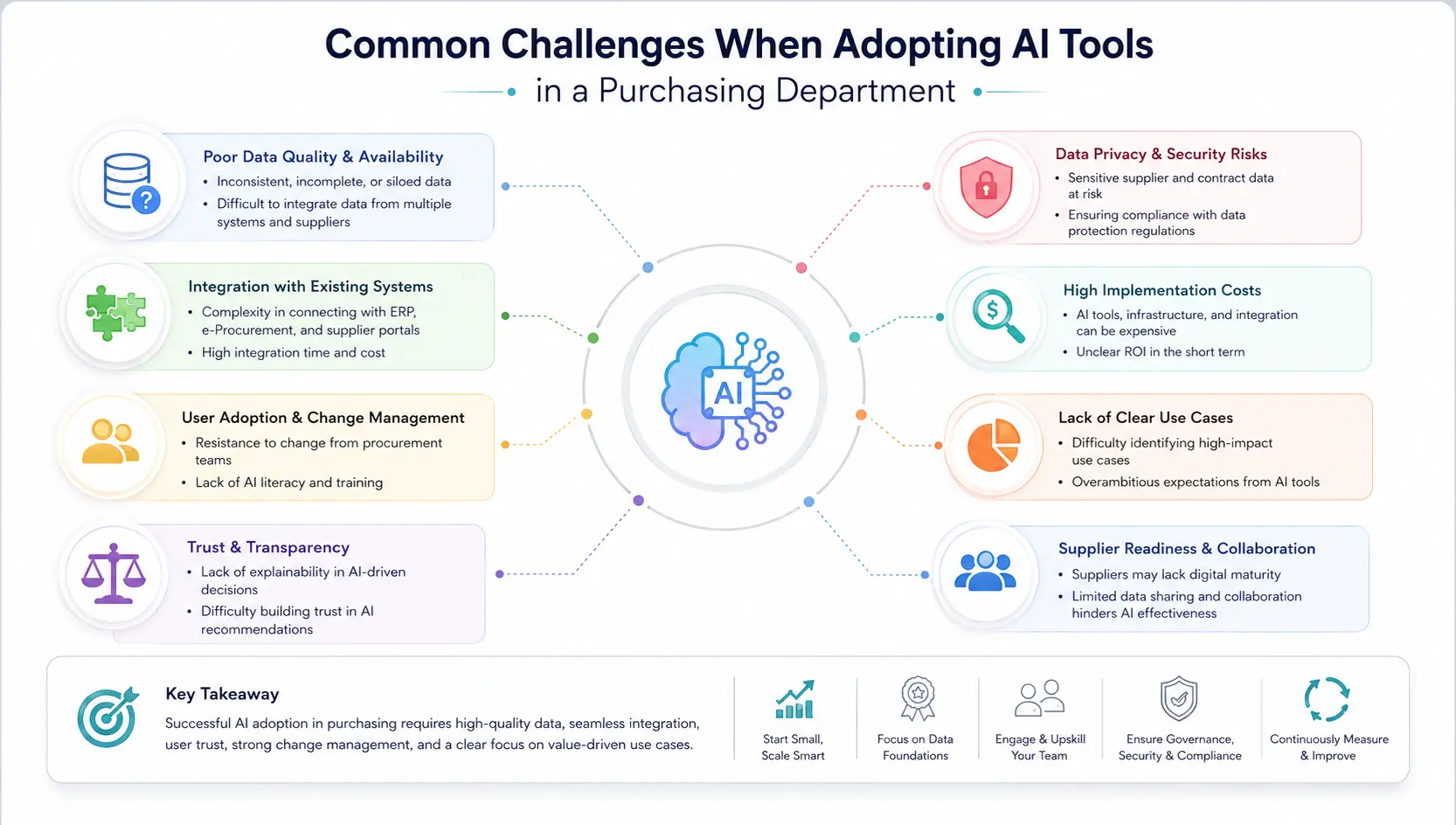
Procurement and supply chain specialists repeatedly cite a common list of obstacles when implementing AI-based purchasing applications. Here are the nine that surface most often in surveys and real implementation projects.
1. Poor Data Quality and Fragmented Systems
AI models are only as good as the data that trains them. Many procurement teams still operate with spend data scattered across several ERP systems, Excel sheets, supplier portals, and email threads. Supplier names are written differently, product categories vary, and historical price data is incomplete. The result is incorrect supplier suggestions, inaccurate spend forecasts, and incomprehensible dashboards.
2. Resistance to Change Among Buyers and Category Managers
Even the most advanced buying tool fails if users don't believe in it or understand it. Experienced buyers who have built personal supplier relationships and negotiated contracts without AI may see such a system as a challenge to their competence, even a threat to their role. The resistance is usually covert: buyers quietly ignore AI recommendations or keep running their old Excel sheets alongside the new system.
3. Integration With Legacy ERP and Procurement Systems
Many ERP systems were never built to connect with newer AI software. Integrating an AI layer requires APIs, middleware, or consultant help. Without seamless integration, AI insights end up displayed on a dashboard that nobody pays attention to.
4. Skills Gap and Lack of AI Literacy
Procurement specialists are experts in negotiation, sourcing, and categories, not data science or machine learning. To trust an AI output, a user needs at least some sense of how it was produced. Without training, users either follow recommendations blindly without scrutiny or distrust the tool entirely and abandon it within weeks.
5. Unclear ROI and Difficulty Securing Budget
AI procurement tools carry licensing, implementation, and integration costs. CFOs and CPOs usually require a business case before approving spend, but the financial benefits, better supplier terms, less maverick spend, shorter cycles, aren't always easy to quantify in the early months. That makes it hard to justify continued use when the tool's real potential is still hidden behind bad data and low user adoption.
6. Vendor and Supplier Data Standardization Issues
Large purchasing departments deal with hundreds or thousands of suppliers represented differently across contracts, invoices, and master data. AI relies on supplier identification and classification to compare prices, find duplicates, or recommend consolidation. If master data management isn't done alongside deployment, even the most sophisticated software will misclassify suppliers.
7. Governance, Compliance, and Risk Management Concerns
Purchase decisions are guided by internal policies, audit procedures, and, in regulated industries, compliance requirements. Once AI participates in purchase and supplier-selection decisions, there must be a clear understanding of how decisions are made, an absence of bias, and a defined process for managing exceptions. Otherwise the organization risks compliance issues and a lack of accountability.
8. Limited Explainability and Over-Reliance on "Black Box" Outputs
Most AI procurement systems give recommendations like "switch supplier to B" or "this contract is high risk." When the logic isn't transparent, two opposite failures occur: some organizations discard the recommendation because they can't evaluate the reasoning, while others take it too literally.
9. An Overcrowded and Confusing Vendor Market
The market is flooded with vendors claiming similar functionality in spend analytics, supplier risk, and contract management. Decision fatigue is common among procurement executives trying to assess the options. Organizations either buy a solution that doesn't fit or wait until it's too late.
Quick-Reference Summary
| Challenge | Core Impact on Purchasing |
|---|---|
| Poor data quality | AI generates inaccurate predictions and vendor recommendations |
| Resistance to change | Users lack confidence in automated recommendations and revert to old habits |
| Legacy system integration | AI becomes an isolated module rather than an integrated process step |
| Skills gap | Employees can't interpret the output or tailor the tool to their needs |
| Unclear ROI | Budget owners hesitate without a measurable savings case |
| Governance and compliance risk | Automated recommendations may conflict with company policy or regulations |
| Vendor and tool overload | A crowded market makes it hard to identify the right product |
4. A Step-by-Step Approach to Successfully Adopting AI in Your Purchasing Department
Knowing the problems is only part of the puzzle. Companies that successfully implement AI in procurement follow a well-defined process. Here's a step-by-step model you can adapt to your needs.
- Audit and clean your procurement data: Before even looking at an AI solution, run an organized data review of spend categories, supplier master data, and purchase order history. Look for duplicate suppliers, mismatched product classifications, and missing information. This one check avoids most "the AI gave us poor recommendations" complaints.
- Define clear, measurable goals: Decide upfront how you'll measure success, improved procurement efficiency, reduced maverick spend, better risk management, or freed-up buyer time for strategic sourcing. Measurable objectives make ROI far easier to calculate and keep you evaluating vendors against your needs, not their feature lists.
- Start with a narrow, high-value pilot: Rather than rolling AI out across all purchasing at once, deploy it in one category or process, automatic invoice reconciliation, say, or risk scoring for your top 50 suppliers. A single pilot is lower-risk, more likely to produce fast wins, and offers a manageable learning experience.
- Involve buyers and category managers early: Get procurement people involved in choosing and designing the technology from the very start. The less friction in using the software, because it was designed with the people who'll actually use it, the better your odds of success.
- Choose integration-friendly tools: Select platforms with proven connectivity to your ERP and e-procurement systems via connectors or APIs. Get clear answers on how the tool will surface recommendations inside the current process rather than behind a new login screen.
- Invest in training and change management: Provide practical training that explains, in understandable terms, how the AI reaches its conclusions. Pair it with change management, internal champions, short seminars, and feedback cycles, so it feels like a transition, not an imposition.
- Establish governance and human-in-the-loop checkpoints: Define which decisions can be fully automated and which need manual review and approval, especially for valuable contracts or critical supplier segments. Document these policies so automated decisions are fully visible for audit and compliance.
- Measure results and scale gradually: Track the KPIs defined in step 2 during the pilot. Once the wins are verified, roll AI out to other categories and regions in well-considered phases, without repeating the pilot's mistakes.
- Continuously refine the model and process: AI in procurement is not a one-off activity. Regularly assess performance, retrain models when supplier conditions change, and keep gathering feedback from the purchasing team.
5. Real-World Case Study: How a Mid-Sized Manufacturing Company Overcame AI Adoption Challenges
To show how these challenges arise in real life, here's a case study reflecting patterns commonly seen in mid-size manufacturing and industrial purchasing departments adopting AI.
Background
An industrial manufacturer with about 450 employees and $60 million in annual procurement spend decided to deploy an AI spend analytics and supplier risk platform. The purchasing department had twelve buyers and category managers covering raw materials, packaging, MRO, and indirect spend.
The Challenges They Faced
- Spend data was scattered across three separate ERP systems and hundreds of spreadsheets, with supplier names entered inconsistently.
- Several senior buyers with 15+ years of experience doubted a machine learning algorithm could grasp supplier relationships as well as they could.
- Finance required a payback case before approving the second-year budget for the AI package.
- IT resources for connecting AI to the current ERP were insufficient.
The Step-by-Step Solution
The procurement leadership followed an approach closely mirroring the framework above:
- They began with three months of data cleansing, standardizing all supplier information against consistent category codes before implementing the AI solution.
- They deployed the solution in a single category, packaging material (8% of total spend), rather than across the whole company at once.
- Two internal buyers were assigned as project champions, given early access to the tool and asked for weekly feedback.
- The AI vendor's integration team built a small connector for the ERP, sending supplier risk alerts to the same purchase-order screen rather than a new dashboard.
- Governance was set: any recommendation below a certain dollar amount was auto-approved, while anything above it was reviewed by the buyer.
- Four months later, they evaluated the pilot results in the packaging category.
The Results
In the pilot category, the firm saw an average 14% decrease in maverick (off-contract) buys, a 22% increase in supplier risk visibility, and a significant drop in buyer time spent manually reviewing low-value purchase orders. Buyer doubts eased quickly once the champions demonstrated, in numbers, how the tool caught pricing mismatches that had gone undetected. On the strength of these wins, the firm rolled the platform out to MRO and indirect spend over the next two quarters.
The critical insight aligns with what procurement studies worldwide find: the stumbling block wasn't the technology, but data readiness, change management, phased implementation, and governance.
6. Key Takeaways for Procurement Leaders
- The challenges of adopting AI in procurement are far more about data, people, and process than about the core algorithm.
- A staged, pilot-led approach consistently beats a big-bang, company-wide rollout.
- Involving procurement professionals from the start significantly reduces resistance to change.
- Proper governance and human-in-the-loop checks ensure compliance and auditability of AI-based procurement decisions.
- Communicating early wins is essential to secure funding for further AI rollout.
Organizations that treat AI implementation as a systematic transformation program, rather than a simple software purchase, are the ones that unlock AI's true potential in their buying and procurement processes.
7. How Gezora.ai Is Helping Industries Integrate AI Into Their Purchasing and Procurement Processes
This is exactly the gap firms like Gezora.ai address. Gezora.ai delivers AI automation solutions for modern businesses, including an AI Procurement Agent alongside applications such as an AI HR Agent, AI Data Processing, AI Chatbot, AI KPI Performance, custom AI agent development, and LLM hosting.
While other companies hand customers a universal solution that may not fit, Gezora.ai acts as an implementation partner, deploying the AI agents and training employees so performance keeps improving even after go-live, precisely the way to overcome the issues outlined above.
In procurement and supplier management specifically, businesses working with Gezora.ai describe how the AI learns their internal preferences and helps make reliable procurement decisions, exactly the level of buyer confidence so often missing from AI implementations. Beyond procurement, they report faster vendor management, less manual departmental reporting, and an easier-than-expected adoption process after onboarding.
On implementation, Gezora.ai notes that most installations take two to four weeks from initial consultation to full deployment, with more complex enterprise rollouts requiring six to eight weeks, well aligned with the phased pilot approach discussed earlier. The company also stresses that no deep technical skills are required on the client side, because its AI agents are designed to be understandable to business users and come with training. Integration with popular business tools is available as part of enterprise implementations, letting companies sidestep the legacy-system integration difficulties that are one of the main barriers to AI adoption in purchasing. On governance and trust, the company commits to solid security and privacy policies, with no use of client data for AI model training without express permission.
For procurement teams who recognize the problems in this article, messy data, reluctant buyers, legacy limitations, and an unclear business case, working with an experienced implementation partner like Gezora.ai offers a way to apply the framework above without reinventing the wheel. The right balance of a capable AI Procurement Agent, effective onboarding, and ongoing optimization is what turns AI adoption into more than just a pilot.
As more procurement departments shift from piloting AI to making it real, the companies that combine internal discipline, clean data, phased rollouts, strong governance, with the right implementation partner will turn AI challenges into procurement performance gains. Learn more at gezora.ai.