Is AI Chatbots Worth It for Businesses?

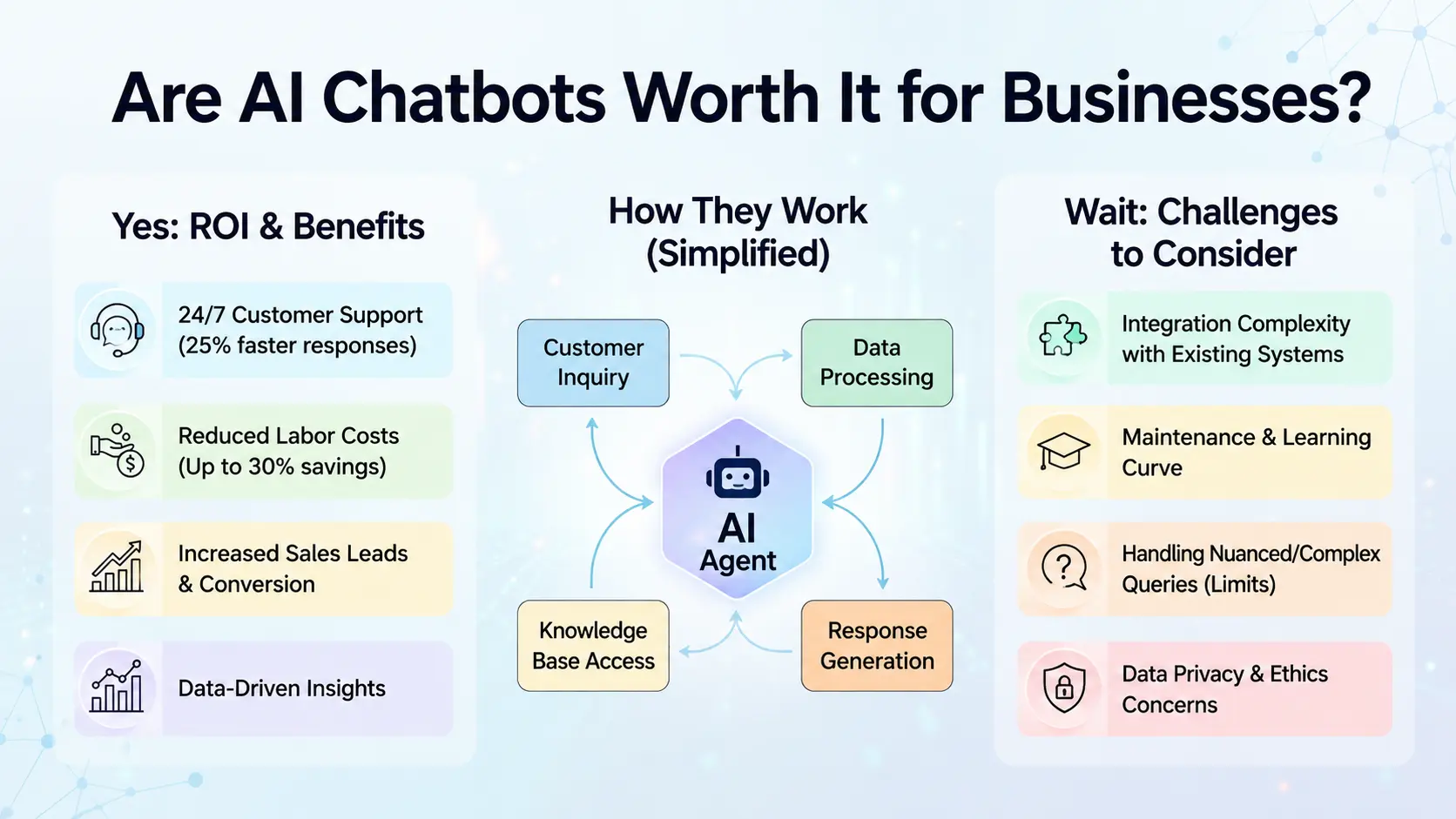
"It's not whether AI chatbots are worth it anymore. It's about how long you can afford to wait."
Table of Contents
- Introduction: The Question Every Business Owner Is Asking
- What Are AI Chatbots and Why Are They Trending?
- The Real ROI: What the Numbers Say
- How to Evaluate If an AI Chatbot Is Right for You
- Real Case Studies: AI Chatbots Delivering Results
- Common Objections and Honest Answers
- Industries Getting the Highest ROI
- What to Look for in an AI Chatbot Solution
- How Gezora.ai Is Helping Industries Integrate AI
- Conclusion: The Verdict on AI Chatbots for Business
1. Introduction: The Question Every Business Owner Is Asking
It's 2:00 am. An interested client in Tokyo arrives at your website wanting to buy something, but they have a few doubts about the price. Your customer support department is offline. What happens next?
If you're among the millions of firms that already use chatbots for customer service, you can be confident the bot will respond immediately, answer the query, and help close the deal. If not, you can easily guess: the buyer moves on to another website.
That is precisely why questions like "Are AI chatbots worth it for businesses?" have become trending searches in the digital revolution era. Entrepreneurs, CEOs, operations managers, and startup owners are all trying to work out whether they should adopt AI-powered conversational technology now or sit tight and wait.
The answer? Yes, but selectively. Here are all the reasons why.
2. What Are AI Chatbots and Why Are They Trending?
AI chatbots are software programs built with artificial intelligence, especially NLP and LLMs, that hold human-like conversations with users in real time. Unlike the old rule-based bots of the early 2010s that followed predefined scripts and couldn't learn or understand human speech, the current generation understands context, copes with nuance, and integrates well into CRM systems and other online platforms.
Why Is Everyone Talking About AI Chatbots Right Now?
Several factors have converged to put AI chatbots at the center of modern business strategy:
- Customer expectations have changed: Consumers now expect 24/7 availability and instant responses across all channels.
- LLM developments: Conversational AI such as GPT-4, Claude, and Gemini has been revolutionary.
- Inflation and cost constraints: High inflation and tight labor markets are driving companies toward automation.
- ROI expectations: Companies want to see clear returns on their investments.
- Business competition: Pioneering companies are already gaining a competitive edge.
| Metric | Data / Finding |
|---|---|
| Global chatbot market size (2024) | $7.76 billion |
| Projected market size (2030) | $27.3 billion (CAGR 23.3%) |
| Businesses using chatbots (2024) | Over 80% of enterprises |
| Customer preference for chatbots (simple queries) | 67% prefer self-service |
| Average response time improvement | From 12 hours to under 2 minutes |
3. The Real ROI: What the Numbers Say
Any investment in technology requires hard evidence and figures. Here is the bottom line on AI chatbot return on investment, drawn from research and practical experience.
Cost Savings
The most obvious source of ROI is the reduction in customer service costs. According to IBM, it is possible to cut customer service operating expenses by 30 percent using AI chatbots. An average support representative may process only 50 to 100 customer requests per day.
A mid-sized SaaS company with 5 support agents at $45,000/year each (total $225,000 annually) can reduce headcount needs by 60% after deploying an AI chatbot, saving over $130,000 per year while improving response times.
Revenue Generation
AI chatbots don't just provide savings, they create revenue in several ways:
- Lead generation: Landing-page chatbots qualify leads continuously, increasing conversions by 10-15%.
- Upselling / cross-selling: AI algorithms suggest products based on online activity.
- Cart abandonment recovery: Abandonment rates decrease by 15% due to chatbot intervention.
- Appointment booking: Service companies automate bookings while avoiding up to 30% no-shows.
Productivity Gains
Beyond customer-facing uses, internal chatbots (HR bots, IT helpdesks, knowledge management) save staff time. According to McKinsey, AI-based automation may let knowledge workers cut 20-30 percent of their daily activity time.
Key ROI Metrics to Track
| Metric | Data / Finding |
|---|---|
| Cost per resolved ticket | Reduced from $15-40 (human) to $0.50-2 (AI) |
| First contact resolution rate | Increased by 18-25% with AI |
| Customer satisfaction (CSAT) | Improved by 10-20 percentage points |
| Average handling time | Reduced by 40-60% |
| Lead conversion rate | Increased by 10-15% with chatbot qualification |
| Employee productivity | 20-30% time saved on repetitive tasks |
4. Step-by-Step Guide: How to Evaluate If an AI Chatbot Is Right for Your Business
Not every organization needs AI chatbots in the same way. It depends on strategic assessment. Here's how to evaluate your situation and the potential ROI of a chatbot investment.
Step 1: Audit Your Current Pain Points
Before investing in any technology, identify the issues you currently face. Answer the following:
- How many customers contact your company each day, week, or month?
- How much of this contact involves repetitive questions such as FAQs, order status, or password resets?
- How fast is your response time, and what impact does it have on customer satisfaction?
- How much time do staff spend on activities that could be automated?
- Are there lost opportunities due to lack of availability during off-hours?
If more than 40 percent of your customer interactions are repetitive and predictable, you already have a high-ROI opportunity with AI chatbots.
Step 2: Define Your Primary Use Case
AI chatbots offer the best return when deployed to solve a specific problem. The most frequent high-value use cases are:
- Customer service chatbots: FAQs, issue resolution, deflecting tickets.
- Lead generation & qualification chatbots: Gathering and scoring leads 24/7.
- E-commerce chatbots: Product suggestions, order updates, refunds.
- HR / IT helpdesk chatbots: Onboarding, internal policies, tech support.
- Appointment booking chatbots: Scheduling, follow-ups, and rescheduling.
- Patient engagement chatbots: Reminders, pre-appointment questionnaires.
Step 3: Calculate Your Potential ROI
Use this simple formula to estimate your first-year ROI:
Estimated Annual Savings = (tickets/month × 12 × % AI can handle × cost per human ticket) − annual chatbot platform cost
Example: 2,000 tickets/month × 12 × 60% AI deflection × $12/ticket = $172,800 saved. Minus $24,000 platform cost = $148,800 net ROI in Year 1.
Step 4: Choose the Right Platform and Integration
Your choice of platform sets your ceiling. Important factors to consider:
- Natural Language Processing ability: How well does it understand your industry's language?
- Integration options: Can it connect with your CRM, ERP, help desk, and e-commerce sites?
- Personalization level: Can it emulate your corporate voice and follow your procedures?
- Analytics and reporting: Does it give insight into its own effectiveness?
- Scalability: Will it grow with your business?
- Data protection and security: Does it comply with regulations such as GDPR and HIPAA?
Step 5: Plan Your Implementation Roadmap
Successful AI chatbot implementations happen in phases:
- Phase 1 (Weeks 1-2): Scope identification, top 20 FAQs and workflows, defining KPIs.
- Phase 2 (Weeks 3-4): Chatbot development, training, and testing.
- Phase 3 (Week 5): Rollout to a small portion of traffic and evaluation.
- Phase 4 (Weeks 6-8): Full implementation with continuous improvement.
- Phase 5 (Ongoing): Periodic evaluation, retraining, and additional applications.
Step 6: Measure, Optimize, and Scale
Once deployed, monitor these KPIs each month: containment rate (the percentage of conversations solved by AI), customer satisfaction, cost per contact, escalation rate to human reps, and revenue generated from chatbot conversations.
5. Real Case Studies: AI Chatbots Delivering Results
Case Study 1: H&M Fashion Retail Transformation
Industry: Fashion Retail | Use Case: Customer Support + Product Discovery
H&M, the Swedish fashion giant, implemented an AI chatbot across its website and mobile app to handle a large volume of consumer queries, including order tracking, size advice, store locating, and returns.
Problem: During sales periods, H&M support staff struggled to keep up. Response times exceeded 48 hours, customer satisfaction fell, and cart abandonment rose.
Solution: H&M launched a conversational AI chatbot connected to its order management system and database, providing instant order tracking and personalized product suggestions based on browsing history.
Outcome:
- Support ticket volume decreased by 40%.
- Response time fell from 48 hours to under 30 seconds.
- Satisfaction score increased by 18 percentage points.
- Chatbot product recommendations drove a 12% rise in average order value.
Key Learning: Integration with live inventory data was the critical success factor. Customers received accurate, real-time information rather than generic responses, which dramatically improved trust and conversion.
Case Study 2: Bank of America (Erica) Financial Services Revolution
Industry: Banking & Financial Services | Use Case: Personal Finance Assistant
Bank of America introduced Erica, a virtual financial assistant that works inside the bank's mobile app. Erica helps customers with balance inquiries, bill payments, transaction search, credit-score checks, and personal finance advice.
Problem: BofA received millions of calls every month about accounts, most of which (balance inquiries, disputes) needed no human intervention.
Solution: Erica uses NLP and predictive analytics to offer proactive suggestions ("You've spent 20 percent more than usual on food this month") and handles 98%+ of routine banking queries without human intervention.
Results (reported publicly):
- More than 1 billion transactions enabled since inception.
- Over 32 million active users.
- Customer service call volume cut by 25% after 18 months.
- NPS rose 14% for mobile banking users.
- Annual savings exceeding $200 million.
Key Learning: Proactive AI that surfaces insights before customers even ask creates significantly higher engagement and loyalty than reactive chatbots that only respond to queries.
Case Study 3: Sephora Beauty E-Commerce Personalization
Industry: Beauty & Cosmetics | Use Case: Product Recommendation + Booking
Sephora created an AI chatbot for Facebook Messenger and its website to help customers with personalized product suggestions, makeup lessons, and in-store appointments.
Problem: Sephora has extensive inventory and per-customer personalization needs, but lacked the capacity to deliver personalized help to every online shopper.
Results:
- 11% increase in in-store makeover appointments versus non-chatbot channels.
- Chatbot users spent 70% more time on the website.
- Chatbot sessions were 3x more likely to convert than solo browsing.
- The chatbot handled 34% of all customer queries in its first year.
Case Study 4: A Mid-Sized E-Commerce Brand (Anonymized)
Industry: E-Commerce | Use Case: 24/7 Support + Cart Recovery
A UK-based online furniture company with roughly $8 million in annual revenue deployed a chatbot to address a 72-hour average response time and a 68% cart abandonment rate.
Implementation Cost: $18,000 (platform license + integration + training)
Results After 12 Months:
- Cart abandonment dropped from 68% to 51% ($340,000 recovered in lost sales).
- Support headcount stayed flat even as orders rose 35%.
- Response time consistently under 90 seconds.
- Customer rating rose from 3.2 to 4.6 out of 5.
- Year 1 ROI: 18x.
Key Learning: For SMEs, the ROI from cart recovery alone can justify the entire chatbot investment within the first quarter of deployment.
6. Common Objections and Honest Answers
"Our customers prefer talking to humans."
Partly true, but research shows 67% of people prefer self-service for routine questions because it's faster. The answer is a mix of both: AI for common issues, humans for exceptions.
"AI chatbots feel impersonal and robotic."
That was the case back in 2018. Today's chatbots, powered by state-of-the-art machine learning models with the right personas, feel natural and warm when done well, as brands like Sephora and Bank of America have shown.
"We are too small for AI chatbots."
The democratization of AI has recalibrated this equation. Small business owners handling 50 to 100 queries per day can earn ROI through low-cost subscription platforms. A $200/month chatbot that saves 20 hours of staff time per week becomes profitable within the first week.
"What about data privacy?"
A valid concern that deserves a real answer. Any trustworthy AI chatbot software supports GDPR, provides data encryption, and clearly states retention policies. Use only chatbots with relevant certifications that let you store data in your preferred location.
"AI will make mistakes and damage our reputation."
Every technological system fails at times. The trick is building the right safeguards: human escalation, confidence thresholds below which the bot defers to a human, and constant monitoring. Done correctly, AI chatbots are usually more accurate than humans at handling structured questions.
7. Industries Getting the Highest ROI from AI Chatbots
While AI chatbots benefit virtually all industries, these see the most impact:
- E-commerce & retail: Cart recovery, product recommendations, order tracking, returns.
- Financial services & banking: Account information, fraud detection, loan qualification, financial advice.
- Healthcare: Appointment booking, symptom assessment, medication reminders, insurance verification.
- Real estate: Property search, virtual tour scheduling, mortgage qualification.
- Travel & hospitality: Booking assistance, itinerary changes, loyalty programs.
- SaaS & technology: Onboarding, in-app chatbots, feature discovery, subscriptions.
- Education: Admission inquiries, course recommendations, learning support.
- HR & recruitment: Candidate assessment, interview scheduling, employee onboarding.
The common denominator across every industry is volume, repetition, and high expectations. Where those align, AI chatbots create enormous returns.
8. What to Look for in an AI Chatbot Solution
Not all chatbot platforms are alike. Use this checklist when selecting one.
Technical Capabilities
- Advanced NLP that understands context, not just words.
- Language support for multiple languages if you have a global clientele.
- Deployment across all channels: website, WhatsApp, Instagram, email, SMS.
- API integration with applications such as CRM, ERP, and help desk.
- Agent handover with full conversation context.
- Analytics dashboard with performance metrics.
Business and Commercial Factors
- Pricing transparency with predictable scaling costs.
- Industry-specific templates and workflows.
- Dedicated implementation and support staff.
- Service level agreements with uptime guarantees.
- A proven track record with verifiable case studies.
Security and Compliance
- SOC 2 Type II certification.
- GDPR compliance and other regional data protection regulations.
- Data residency options.
- Role-based access control.
- Audit logging and message archiving.
9. How Gezora.ai Is Helping Industries Integrate AI Into Their Processes
"The question is no longer whether to adopt AI, but how fast you can implement it without disrupting your operations. That is exactly the challenge gezora.ai was built to solve."
As AI chatbots move from exciting novelty to business necessity, a new breed of company is rising: AI solutions focused on integration within industries rather than just offering chatbot creation. Gezora.ai is one such company.
What Is Gezora.ai?
Gezora.ai is an AI-based platform that helps businesses build conversational AI and intelligent automation solutions tailored to their needs. Unlike platforms focused on ready-made chatbots, the company engages with business stakeholders to determine where they can automate operations using AI.
Gezora.ai's Industry Integration Approach
The key difference between Gezora.ai and regular chatbot providers is its depth-first approach. Rather than handing customers a chatbot app and instructions, the company begins with an AI readiness assessment, determining how ready a customer's workflows are for automation, calculating ROI, and then building an app specifically for each client.
- Retail & e-commerce: Gezora.ai has partnered with established and emerging D2C brands to implement AI assistants across the customer journey, from product discovery to order management and post-order service. With integrations for Shopify, WooCommerce, and Magento, its solutions provide real-time stock visibility, dynamic pricing adjustments, and subtle, intelligent upsells.
- Healthcare: This industry requires higher accuracy and rigor than generic AI provides. Gezora has built HIPAA-certified assistants that handle appointment booking, pre-appointment forms, post-appointment follow-ups, and insurance verification while maintaining privacy at all times, cutting administrative workload by 35% for clients and lifting patient engagement scores.
- Financial services: In an industry built on trust and precision, Gezora.ai develops AI customer service tools for account queries, initial loan-application screening, investment product information, and fraud alerts. Advanced conversation design keeps it compliant with financial regulations while delivering an optimal experience.
- Real estate: Gezora.ai's solutions help developers, agencies, and proptech firms automate lead qualification, property matching, virtual tour scheduling, and mortgage pre-qualification. One regional real estate firm increased qualified leads processed monthly by 45%.
- Manufacturing & logistics: Beyond customer-facing products, Gezora.ai deploys internal AI such as IT help desks, HR query automation, supply-chain tracking bots, and vendor assistance systems, generating 20-35% savings in operational support costs.
Gezora.ai Core Differentiators
- Industry-specific AI: Pre-built models and workflows tuned to each industry's terminology, regulations, and customer needs.
- End-to-end responsibility: Full management of AI implementation from strategy through deployment and continuous optimization.
- Deep integrations: Native connectors for popular CRMs, ERPs, e-commerce systems, and help desks, so AI works with existing technology rather than alongside it.
- Human-in-the-loop development: Intelligent escalation policies balance AI efficiency with human input.
- Continuous optimization: Retraining and monitoring keep AI systems effective as business conditions change.
- ROI measurement: Custom dashboards show clients the costs saved, income generated, and efficiency gained.
The Gezora.ai Partnership Model
Gezora.ai is not just another tech provider but a true business partner. For Gezora.ai, success is measured by client outcomes: deflecting tickets, converting leads, saving time, and making money. That result-oriented approach is why Gezora.ai is trusted by businesses of all sizes, from startups to enterprises, across the Middle East, South Asia, and beyond.
Businesses that have moved past "should I use this technology?" to "how do I leverage AI?" stand to benefit from Gezora.ai's domain knowledge, technical skills, and strategic approach. Find out how Gezora.ai can help implement AI at your company by visiting gezora.ai.
10. Conclusion: The Verdict on AI Chatbots for Business
So, is there any benefit to using chatbot technology for business? There is. Used wisely, a well-integrated AI chatbot is invaluable. It will not only automate work but also significantly optimize your business performance.
The companies succeeding with chatbots aren't those who invested in the most complex AI. They're organizations that identified their pain areas, selected the right solution, invested in quality training data, and treated deployment as an ongoing process rather than a one-time event.
The stakes rise each month you wait. Every month without AI chatbots lets your rivals improve their response time, efficiency, and client retention while cutting operating costs. The gap widens with every quarter.
Fortunately, there has never been a better time to invest, as the entry threshold has never been lower. With solutions like Gezora.ai, even the smallest organization can afford to use AI.
It's no longer about whether AI chatbots are worth it. It's about how long you can afford to wait.
Key Takeaways
- AI chatbots provide proven ROI in cost savings, revenue generation, and efficiency.
- The highest-ROI use cases revolve around high-frequency, repetitive customer interactions.
- Effective adoption calls for a structured assessment and deployment process.
- Real deployments at H&M, Bank of America, and Sephora prove ROI at enterprise scale.
- SMEs can generate 10x to 18x ROI within the first year through targeted deployment.
- Choosing the right platform pays off, as industry-specific solutions beat general-purpose chatbot makers.
- Gezora.ai is empowering companies across industries to make their AI strategy work.
The question isn't whether AI chatbots are worth it. It's how long you can afford to wait.