The Definitive B2B Chatbot Design Guide: How to Build an Effective Conversational Interface for Customer Support

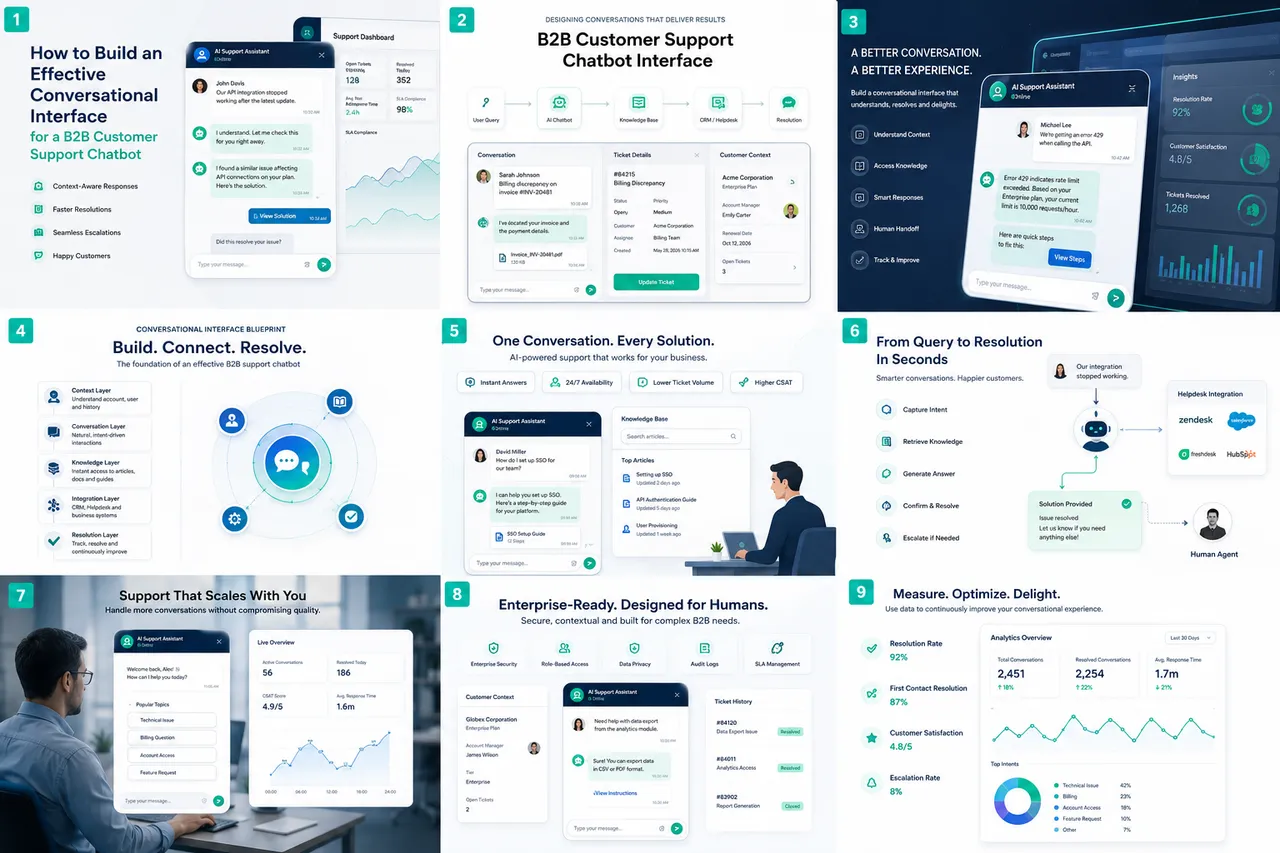
"Your chatbot is not a cost-reduction tool. It is a relationship interface that operates at the moments when your clients need you most. Design it like it matters. Because in B2B, it absolutely does."
Table of Contents
- Introduction: The Support Portal Problem
- Step 1: Why B2B Chatbot Design Is Fundamentally Different
- Step 2: Map Your User Personas and Conversation Context Architecture
- Step 3: The 6 Conversational Design Principles That Define B2B Chatbot Quality
- Step 4: Real Case Study: How Zendesk Rebuilt Its Own B2B Support Chatbot
- Step 5: Connect Your Chatbot to the Systems That Make It Intelligent
- Step 6: Measure What Matters and Optimise Continuously
- How Gezora.ai Helps B2B Companies Build Chatbots That Actually Work
- The Bottom Line: Design First, Automate Second
Introduction: The Support Portal Problem
Picture your highest-value enterprise client. They have a time-sensitive issue: a broken integration, an urgent billing discrepancy, a compliance query that needs an answer before a board meeting in two hours.
They visit your support portal. They click the chat widget. And what greets them is a bot that says: "Hi! I'm here to help. Please choose from the following options: 1) Technical Issue 2) Billing 3) Account."
They close the window. They call the account manager's mobile. And somewhere in your CX metrics, a silent churn signal just registered.
This is the single most common failure mode in B2B customer support chatbots: the technology exists, but the conversational design does not. And in a B2B context where relationships are long, contracts are large, and a single frustrated client can represent millions in at-risk revenue, the gap between a well-designed chatbot and a poorly designed one is not cosmetic. It is existential.
This guide gives you the step-by-step framework to build a B2B customer support chatbot conversational interface that your clients will actually use, trust, and value.
Step 1: Why B2B Chatbot Design Is Fundamentally Different
The single biggest mistake in B2B chatbot design is importing B2C assumptions into a business context where they do not belong. B2B support interactions are structurally different from consumer conversations in ways that must shape every design decision you make.
| B2C Chatbot Context | B2B Chatbot Context |
|---|---|
| Single user, single decision | Multiple stakeholders per query (IT, finance, legal, ops) |
| Low-stakes transactions | High-stakes, often contractual interactions |
| Casual, informal tone acceptable | Professional, precise language required |
| Resolution in one session typical | Multi-session, tracked issues common |
| Generic FAQs work reasonably well | Company-specific workflows and SLAs essential |
| Anonymous interactions common | Named account context is always relevant |
THE CORE PRINCIPLE In B2C, a chatbot that resolves 70% of queries is a success. In B2B, the 30% it fails on may represent your most important clients with your most complex, revenue-critical issues. B2B chatbot design must be built from the hardest case down, not the easiest case up.
Step 2: Map Your User Personas and Conversation Context Architecture
Before writing a single line of conversation flow, you need a precise map of who will use the chatbot and what they need from it. In a B2B environment, "the user" is rarely one person. It is a constellation of roles, each with different technical literacy, different urgency levels, and different definitions of a successful outcome.
Define Your B2B User Personas
For most B2B service companies, support chatbot users fall into four primary personas:
- The Technical Contact: often an IT manager or developer; needs precise, jargon-accurate responses; values speed and documentation links over conversational warmth.
- The Business Buyer: typically a VP or director; rarely visits support unless an issue is escalating; needs executive-level clarity and immediate escalation paths.
- The Operational User: a day-to-day practitioner of your platform; highest frequency user; values consistency and quick resolution of known issues.
- The Finance / Compliance Contact: arrives for invoicing, contract, or regulatory queries; requires precise, auditable responses and often needs documentation.
Build a Context Architecture
A context architecture defines what information your chatbot needs to hold across a conversation to deliver an intelligent, non-repetitive experience. For B2B, this minimum context layer should include:
- Company account ID and tier (enterprise, mid-market, SMB), which determines SLA and escalation priority.
- Contact name and role, pulled from CRM on login.
- Open and recent support tickets, pulled from helpdesk integration.
- Current product/service subscription and known configuration.
- Preferred language and timezone.
Step 3: The 6 Conversational Design Principles That Define B2B Chatbot Quality
Conversational interface design for B2B support is both a technical and a linguistic discipline. These six principles are the difference between a chatbot your clients use and one they abandon.
01. Acknowledge Before You Answer Always confirm what the user asked before providing a resolution. In B2B, where queries can be complex and multi-part, a brief restatement builds confidence and prevents the frustration of receiving an answer to a different question. Example: "Got it: you are asking about the API rate limit on your Enterprise tier. Here is exactly what applies to your account."
02. Use Progressive Disclosure Never front-load all available information. Start with the single most likely resolution, then offer to go deeper. B2B users, especially technical contacts, will ask follow-up questions if the first response does not resolve their issue. Overloading the first response increases abandonment rates by up to 47% (Drift, 2025).
03. Maintain Consistent Professional Tone B2B chatbot language should be warm but precise. Avoid slang, excessive exclamation marks, and scripted enthusiasm. Your chatbot is representing your brand to a CFO and a DevOps engineer simultaneously. The tone should work for both. Develop a specific tone guide before writing any dialogue.
04. Build Graceful Escalation Paths The most important conversation in a B2B chatbot is the one that transfers to a human. Define precise escalation triggers, including account tier, issue complexity, emotional signal words, and number of failed resolution attempts. Make the handoff seamless, passing full conversation context to the agent so the client never has to repeat themselves.
05. Design for Multi-Turn, Not Single Exchange B2B support issues rarely resolve in one exchange. Your conversational interface must be designed to hold context across multiple turns, reference earlier information in the conversation, and guide users through multi-step resolution processes without losing coherence.
06. Close Every Conversation Intentionally Never let a B2B chatbot conversation end with an unresolved trailing message. Every conversation should close with a confirmation of resolution, a follow-up action summary if applicable, and an offer to escalate or reopen. This transforms a support interaction into a relationship touchpoint.
Step 4: Real Case Study: How Zendesk Rebuilt Its Own B2B Support Chatbot
CASE STUDY: Zendesk | B2B SaaS CX Platform | 160,000+ Business Clients Challenge: Scaling enterprise support quality across a rapidly growing global customer base without proportional headcount growth.
Zendesk, a company that literally sells customer support technology to B2B companies, faced a pointed credibility challenge in 2023: its own support chatbot was underperforming. With 160,000 business clients ranging from startups to Fortune 500 enterprises, the chatbot was resolving just 28% of queries autonomously, driving excessive escalation volume, and generating internal feedback that it was "not fit for enterprise clients."
Zendesk undertook a full conversational interface redesign applying the principles now recognised as B2B chatbot best practices. The redesign focused on three core changes: persona-based conversation routing, contextual account integration pulling live data from client accounts, and a redesigned escalation framework with full context transfer.
Results after 9 months:
| Metric | Result |
|---|---|
| Autonomous resolution rate | 72% (up from 28%), a 157% improvement |
| Average handle time for escalated conversations | 34% reduction |
| Client CSAT score for chatbot interactions | 4.6/5 (was 2.9) |
| Support tickets reaching human agents | 41% decrease |
The most significant finding from Zendesk's redesign process was that the improvement in autonomous resolution was not primarily driven by better AI. The underlying model was largely unchanged. The gains came from conversational design: better persona routing, clearer dialogue structures, more intelligent escalation triggers, and context-aware response logic.
THE LESSON The quality of your chatbot's conversations is more dependent on design decisions than on the AI model powering them.
Step 5: Connect Your Chatbot to the Systems That Make It Intelligent
A B2B support chatbot operating in isolation, with no access to account data, ticket history, or product configuration, is not a conversational interface. It is a sophisticated FAQ page. The integrations below are what transform it into a genuine support intelligence layer.
| Integration | What It Enables | Priority |
|---|---|---|
| CRM (Salesforce / HubSpot) | Account recognition, tier identification, relationship history, named contact personalization | Critical, deploy first |
| Helpdesk (Zendesk / Freshdesk) | Live ticket status, open issue history, SLA tracking, automatic ticket creation from chat | Critical, deploy first |
| Knowledge Base | Dynamic answer retrieval from product documentation, release notes, and known issue logs | High |
| Product / Platform Data | Account configuration, usage metrics, error logs, enables diagnostic conversations | High |
| Calendar / Scheduling | Instant meeting booking with account managers or support engineers directly from chat | Medium |
| Billing System | Real-time invoice status, payment history, contract renewal data for finance queries | Medium |
Step 6: Measure What Matters and Optimise Continuously
A B2B support chatbot is not a deployment project. It is an ongoing design programme. The metrics below separate chatbots that improve over time from those that plateau and decay.
- Autonomous Resolution Rate (ARR): Percentage of conversations fully resolved without human escalation. B2B target: 60 to 75% for mature deployments. Below 50% signals fundamental design or integration gaps.
- Containment Rate by Issue Type: Break down ARR by query category. A high overall ARR can mask catastrophic failure on specific high-value issue types such as enterprise billing or SLA disputes.
- Time-to-Resolution (TTR): Average time from first message to confirmed resolution, including escalated conversations. Compare chatbot-handled vs. human-handled to identify where AI adds genuine speed value.
- Escalation Quality Score: Measure whether escalations are triggering for the right reasons. Over-escalation wastes human agent capacity. Under-escalation damages client relationships on complex issues.
- CSAT by Channel and Persona: Collect satisfaction scores specifically for chatbot interactions, segmented by user persona. A technical contact and a VP should both leave satisfied, but their definitions of satisfaction differ significantly.
- Fallback Rate: The percentage of conversations where the chatbot fails to understand the query and returns a fallback response. Any fallback rate above 8 to 10% indicates training data or NLP model gaps.
- Churn Correlation Signal: The most advanced metric. Track whether unresolved chatbot interactions correlate with client churn signals in your CRM. This directly connects chatbot performance to revenue retention.
How Gezora.ai Helps B2B Companies Build Chatbots That Actually Work
The gap between knowing how to design an effective B2B chatbot conversational interface and actually building, integrating, and optimising one is where most internal teams get stuck. The conversational design principles are clear. The integration requirements are well-defined. The ongoing optimisation process is established. But executing all three simultaneously, while managing your actual business, requires a partner who has done it before.
Gezora.ai has been working directly with B2B organisations across SaaS, logistics, professional services, manufacturing technology, and financial services to design and deploy AI-powered customer support chatbots that deliver measurable improvements in resolution rates, client satisfaction, and support cost efficiency.
Gezora's approach is built around three phases that address the most common failure points in enterprise chatbot deployments:
- Phase 1: Design and Architecture: Gezora maps your B2B client personas, conversation flows, tone guidelines, escalation logic, and context architecture before a single line of code is written. Design decisions are validated against your actual support ticket data.
- Phase 2: Integration and Deployment: Gezora connects your chatbot to your CRM, helpdesk, knowledge base, and product systems, building the integration layer that transforms a chat widget into an intelligent support interface.
- Phase 3: Optimisation and Growth: Ongoing conversation analysis, fallback rate monitoring, CSAT tracking, and quarterly redesign cycles ensure your chatbot improves continuously rather than degrading over time.
Learn More: Visit gezora.ai to explore how they help B2B companies design and deploy AI-powered customer support chatbots that deliver enterprise-grade conversational experiences. Book a free B2B chatbot audit and discover your current resolution rate gap.
The Bottom Line: Design First, Automate Second
The B2B companies winning at customer support in 2026 are not the ones with the most powerful AI model behind their chatbot. They are the ones that invested in understanding their clients deeply enough to build conversations those clients actually want to have.
The framework is clear: map your personas, architect your context layer, apply the six conversational design principles, integrate your critical systems, and measure relentlessly. Every step skipped is a client conversation that fails, and in B2B, a failed support conversation is not just a service issue. It is a retention risk.
Your chatbot is not a cost-reduction tool. It is a relationship interface that operates at the moments when your clients need you most. Design it like it matters. Because in B2B, it absolutely does.
Great B2B chatbots are not built. They are designed, conversation by conversation.