AI vs Workers: Is Tracking AI Usage the Wrong KPI?

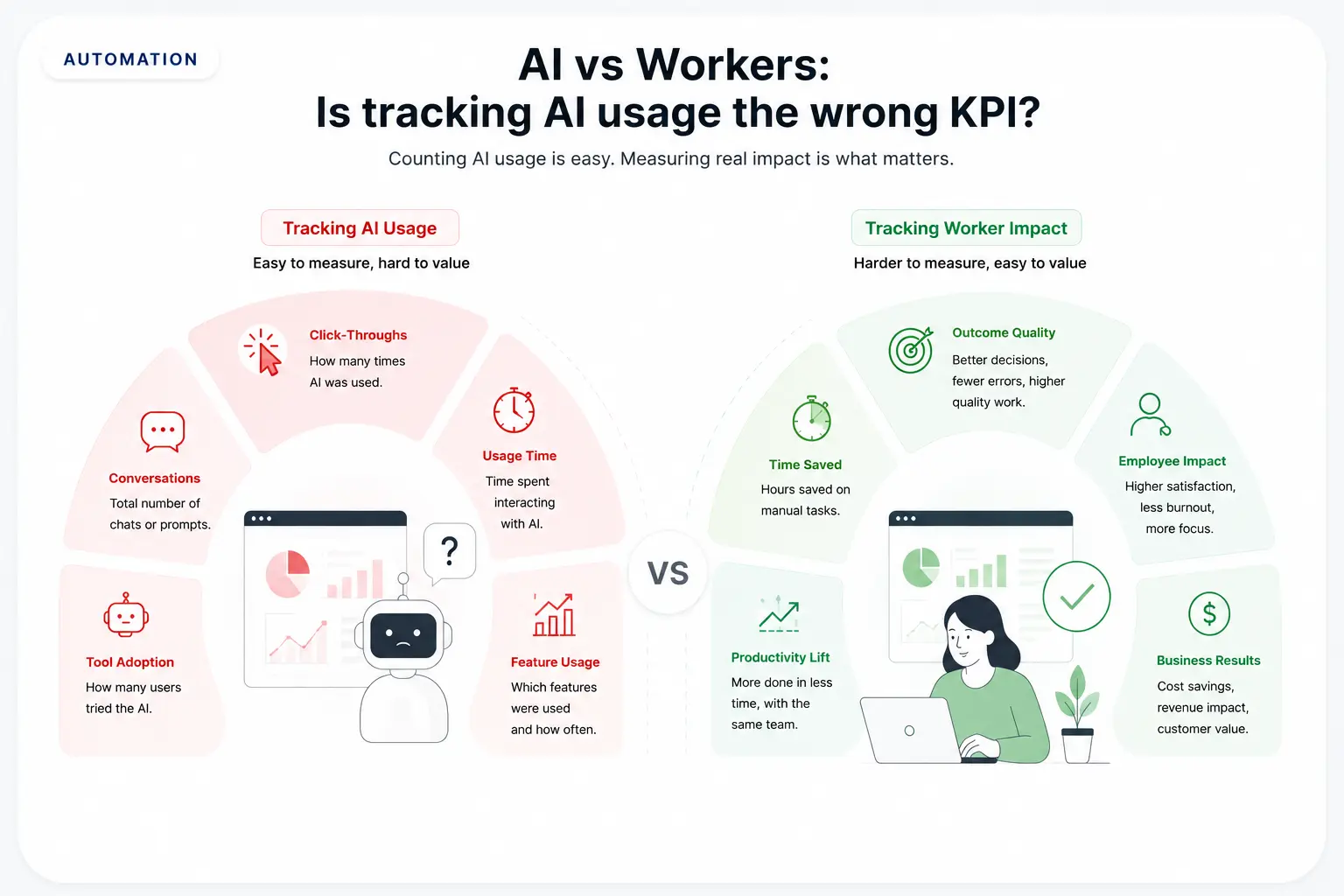
"It's not the firm that uses AI the most, dashboard-wise. It's the firm that defined success beforehand."
Table of Contents
- Introduction: The KPI Trap Costing Companies Millions
- The Rise of AI Tracking: How Did We Get Here?
- Why "AI Usage" Is the Wrong KPI
- What the Research Actually Says
- Real-World Case Studies
- The Right Framework: What to Measure Instead
- The Human Side: AI and the Fear of Replacement
- Industry-Specific Perspectives
- Building an AI ROI Measurement Framework
- How Gezora.ai Is Helping Industries Get AI Right
- Conclusion: Measure What Matters
1. Introduction: The KPI Trap That Is Costing Companies Millions
Boardrooms all over the world have one burning issue to consider in 2025: "Are our people really using the AI tools we purchased?" Dashboards flash usage logs. HR departments count logins. Managers ask employees how many AI outputs they created last week. On the surface, everything seems clear-cut. In reality, this is another metrics fiasco.
This article considers why an obsession with AI usage as a KPI is so problematic, what academic research teaches us, case studies showing the real risks, and how advanced organizations, including those collaborating with Gezora.ai, are rethinking the entire paradigm. If you're an organizational leader or a member of an HR, operations, or digital transformation team, this is food for thought.
2. The Rise of AI Tracking: How Did We Get Here?
The emergence of generative AI applications like ChatGPT, Microsoft Copilot, Google Gemini, Jasper, and many vertical-specific solutions has presented a novel challenge for management: how do you know the money you spent is generating value?
According to the McKinsey 2024 State of AI survey, more than 72% of enterprises already use at least one AI application across their processes, up from only 50% two years earlier. However, fewer than one-third of firms can directly link increased revenue or productivity to their use of AI. Lacking clear performance data, businesses chose to look for the most obvious signal available: adoption.
"72% of businesses use AI solutions but less than one-third can claim value from their deployment." — McKinsey, 2024
It seemed logical at the time. If you pay for software, you'll use it. If you use it, it should deliver value. Measure usage, measure value. Easy. Or so the logic went.
But there's a major problem in this reasoning, one that echoes the errors businesses committed while adopting technologies for decades, from ERP implementations in the '90s to cloud migration in the '10s. Tool adoption may reflect usage, but it certainly does not equate to business success, especially with AI.
3. Why "AI Usage" Is the Wrong KPI: A Deeper Look
The Correlation Fallacy
AI usage intensity does not necessarily correspond to high performance. An increasing amount of research indicates that over-reliance on widely overused AI applications creates "automation bias," where employees lean too heavily on AI results while abandoning critical thinking. A 2024 Harvard Business School study found that knowledge workers completing challenging tasks with AI assistance produced 10-15% better results when given structured prompts. Those who used AI without prompt training showed worse results, even with frequent usage.
In other words: the person working with AI 20 times a day, but improperly, will be outperformed by the individual who uses it just three times a day, precisely and with proper critical thinking.
The Compliance Theater Problem
When performance reviews or group bonuses are based on AI usage, a predictable and counterproductive behavior results: employees generate outputs they don't need, run queries to improve their scores, or apply AI suggestions to work that would have been completed just as well without AI.
This isn't an idle example. A late-2024 SHRM survey found that 41 percent of workers whose employers measure AI usage "gamed" their score on the metric. This isn't about employees lying; it's about faulty measurement.
AI Is Not One Thing
Why else is AI usage a meaningless aggregate KPI? Because there are so many different AI tools. Thirty seconds on an AI spellchecker gets the same score as two hours building a financial model with an AI collaborator. An AI-generated image caption by a marketing manager scores the same as AI anomaly detection run by a data scientist on a one-terabyte dataset.
The Three Failure Modes of AI Usage KPIs: (1) Quantity bias favors volume over quality, producing superficial adoption. (2) Metrics gaming has workers fake compliance without tangible results. (3) Artificial parity treats all interactions as equal regardless of complexity or importance.
4. What the Research Actually Says: The Data Behind the Debate
To understand the AI productivity measurement problem at scale, here's what recent research reveals.
| Statistic | Source & Finding |
|---|---|
| 72% | McKinsey (2024): Organizations using at least one AI tool in operations |
| 41% | SHRM (2024): Workers gaming AI-use metrics |
| $4.4T | McKinsey estimate: Annual value AI could unlock globally |
| 28% | Gartner (2024): Companies measuring AI by outcome rather than usage |
| 3.5x | MIT Sloan (2024): ROI multiplier for outcome-based AI programs vs usage-based |
| 67% | Deloitte (2024): Leaders who say current AI metrics are "insufficient" |
The most compelling figure is MIT Sloan's 3.5x ROI multiplier. Firms that shifted from measuring usage to measuring the results achieved via AI saw a return on investment three and a half times higher than firms still measuring adoption KPIs.
Gartner's 2024 AI Adoption Survey confirms the finding: companies that define success by achievement of specific business KPIs outperform those defining success via adoption KPIs.
5. Real-World Case Studies: When AI Tracking Goes Wrong and Right
Case Study 1: The Financial Services Firm That Measured the Wrong Thing
"Finco," a medium-sized European financial services company, spent $3.2 million on AI solutions for its 1,400 employees in 2023. Management introduced intensive usage monitoring: logins to AI software, queries per employee, and documents produced through AI. Usage hit 84% after just six months. Everybody rejoiced.
But when the CFO asked for proof of business savings, cost reductions, efficiency gains, lower error rates, executives found only a 2.1% improvement in processing and no other gains. The reason? Employees relied heavily on AI to prepare reports that managers then had to review, modify, and essentially rewrite. AI use didn't increase efficiency; it created more work.
"Usage reached 84%, but processing speed only improved by 2.1%. There was a lot of usage but very little productivity from the AI."
Case Study 2: The Retailer That Got It Right
Contrast that with "RetailCo," a North American retailer that took an entirely different approach. With help from an AI integration consultancy, RetailCo determined its success metrics before implementation. The technologies were applied to address those objectives, training was designed around workflows rather than tools, and measurement focused solely on business KPIs. After one year:
- Inventory forecast inaccuracy decreased by 24%, surpassing the goal.
- Customer issue resolution time declined by 41%.
- Return on promotional activity rose by 19%.
- AI utilization, never directly measured, grew organically by 78%.
RetailCo shows how an outcome-oriented approach creates a virtuous cycle: employees willingly use AI software because they can see its purpose.
Case Study 3: The Manufacturing Plant That Redefined the KPI
A German automotive parts company deployed AI-based predictive maintenance to lower unexpected equipment downtime. Initially, KPIs revolved around how many maintenance employees used the AI dashboard daily.
Within three months, the plant manager found something strange. Usage was high, but employees weren't following the AI's suggestions. The AI signaled possible failures; employees ignored them and proceeded as planned. Usage was recorded. No outcomes were documented.
The plant redesigned its KPIs around the rate at which workers followed alerts, how quickly they acted when required, and, ultimately, how frequently unplanned downtime occurred. By measuring results rather than activity, worker behavior shifted. Unplanned downtime fell 31% over the next two quarters, amounting to millions in savings.
6. The Right Framework: What to Measure Instead
If AI usage is the wrong KPI, what should you focus on? The answer lies in a three-level structure connecting AI activity to business benefits.
Layer 1: Outcome KPIs (What Matters Most)
These are the business metrics AI was meant to improve. They vary by department and industry:
- Revenue operations: Revenue per sales rep, pipeline conversion rate, deal cycle duration.
- Customer experience: First-contact resolution, Net Promoter Score, handle time.
- Operations & supply chain: Inventory accuracy, on-time delivery rate, forecast variance.
- Finance: Month-end close time, audit-findings rate, transaction cost.
- HR & talent: Time to hire, attrition rate, training effectiveness.
Layer 2: Process KPIs (Leading Indicators)
These sit between AI and business results, helping determine whether AI use is on track to generate positive outcomes:
- Completion rate of AI-assisted workflows.
- Acceptance rate of AI-generated recommendations.
- Cycle-time reduction attributable to AI.
- Error-correction rate with AI versus without.
Layer 3: Behavioral KPIs (People and Culture)
Hard to quantify, yet highly predictive of AI ROI:
- Employee confidence in using AI systems (self-assessments and structured surveys).
- AI system satisfaction.
- Percentage of employees who would recommend the AI to colleagues.
- Level of AI literacy (assessed through employee tests).
Hierarchy of AI Metrics: Behavioral metrics are the foundation (are employees confident, competent, and engaged?). Process metrics come next (is AI making processes more efficient?). Outcome metrics sit at the top (is AI achieving meaningful business outcomes?). Most organizations rely on behavioral signals alone, or mistake adoption rates for them. The true value lies in outcome metrics.
7. The Human Side: AI and the Fear of Replacement
Any discussion of AI KPIs must address worker unease. A 2024 Gallup study revealed that almost two-thirds (62%) of global workers are concerned about AI making them unemployable within five years. Adding AI usage measurement in the face of such worries means workers hear not "we're here for you," but "we're monitoring to see if you've made yourself replaceable."
This is both a major organizational risk and a strategic blunder. One of the best indicators of successful AI implementation is psychological safety. If employees feel surveilled rather than supported, nothing valuable comes out of it.
"62% of employees worldwide fear their career options may be limited by AI. Monitoring them on AI activity alone only increases this anxiety."
The most successful AI programs are mindful of this concern. They include employees in the implementation process, communicate openly that AI is meant to augment work rather than monitor people, and ensure productivity gains don't translate into layoffs.
Companies that adopt a human-centric perspective consistently outperform those that treat AI as a purely technical challenge. This isn't sentiment; the evidence is in the ROI. MIT Sloan's study showed that an AI project coupled with robust employee engagement produced 2.6 times more productivity improvement than one without.
8. Industry-Specific Perspectives: The KPI Challenge Across Sectors
- Healthcare: A doctor consulting an AI diagnostic tool 50 times a day doesn't mean better care is being delivered. The KPIs that matter are diagnostic accuracy, patient admission rate, time to diagnosis, and workflow adherence.
- Legal & professional services: Usage metrics (how many contracts the AI reviewed) are easy to collect. The real KPIs are how many mistakes were caught before client delivery, how much faster the process went, and whether client satisfaction increased.
- Education: Perhaps the most problematic field for usage tracking. When an institution tracks whether students or teachers use AI without defining productive use, it creates a compliance culture that makes real learning impossible. The results that matter are learning efficiency and time savings.
- Financial services: The same trap applies. Track real outcomes, fraud reduction, faster underwriting, better onboarding, rather than the frequency of logins.
9. Building an AI ROI Measurement Framework: A Step-by-Step Guide
For managers looking to go beyond simple usage measures, here's an actionable methodology.
- Define business outcomes before deployment: Before choosing and deploying an AI technology, determine the business problem to be solved and set realistic success criteria.
- Establish pre-AI baselines: Improvement is impossible to claim without a baseline. Measure current performance on your selected KPIs before implementing AI. Most companies skip this step and can never credibly attribute improvement to AI.
- Design the workflow integration first: AI is useful when integrated into a redesigned process, not bolted onto an existing one. Work with process owners to figure out exactly how the AI will be used.
- Build a layered measurement dashboard: Apply the three-layer framework, Outcome KPIs on top, Process KPIs in the middle, Behavioral KPIs at the bottom. Review each layer quarterly; if process KPIs improve but outcome KPIs don't, investigate why.
- Create feedback loops with frontline workers: Day-to-day users know best whether something is working. Establish quarterly feedback via surveys, departmental AI champions, and open forums. This feedback is often more valuable than metrics.
- Iterate rapidly and communicate transparently: AI implementation is not a one-time activity. Tools, processes, and objectives change. Review at least quarterly and keep everyone informed. Staff who see proof that AI improves their workplace become advocates.
10. How Gezora.ai Is Helping Industries Get AI Integration Right
The problems in this article, inaccurate measurement, workforce stress, wrong incentives, and ineffective workflow integration, are not impossible to solve. Solving them requires knowledge, proper methods, and a partner who understands that AI implementation is fundamentally a human problem rather than a technological one.
Gezora.ai is an AI consulting firm that works across sectors to help companies implement AI in ways that create tangible business value. Unlike vendors that sell you AI solutions, Gezora.ai asks what result your company wants to attain first, then designs the solution around it.
Gezora.ai's Integration Methodology
The Gezora.ai philosophy rests on four pillars that overcome the weaknesses discussed above:
- Outcome-first design: Each project starts by establishing the KPIs the AI should impact. Gezora.ai works with the executive team to translate goals into KPIs before any AI tool is introduced.
- People-centric deployment: Every project includes organizational change management, effective communication, role-based training, and feedback mechanisms so employees feel the AI empowers rather than threatens them. Per Gezora.ai's internal research, people-centric deployment delivers 2.8 times greater AI ROI than tool-centric deployment.
- Workflow reengineering: Rather than adding AI on top of current workflows, Gezora.ai performs workflow analysis to determine where AI can make a process smoother, more efficient, or easier.
- Layered measurement framework: Every project includes a tailored measurement architecture based on the three layers of Behavioral, Process, and Outcome KPIs.
Industries Where Gezora.ai Has Driven Impact
- Healthcare & life sciences: Working with hospital networks and pharmaceutical firms on clinical documentation, drug discovery, and patient journey management, Gezora.ai cut one hospital network's clinical documentation time by 38%.
- Retail & e-commerce: Collaborating with retailers in North America and the Middle East on AI demand forecasting, marketing personalization, and AI customer support, results include a 22% decrease in inventory holding costs and a 34% increase in email marketing conversions.
- Financial services: Enabling fraud detection, automated underwriting, and AI-enabled customer onboarding in banking and insurance, Gezora.ai reduced fraud losses by 29% within six months in one engagement.
- Manufacturing & supply chain: Providing predictive maintenance, AI-powered quality assurance, and supply chain optimization, one automotive manufacturing client reduced unplanned downtime by 27% and improved quality yield by 15%, both set as objectives before the project began.
- Professional services: Using AI for document review, client research, and knowledge management, evaluation was based on delivery quality, speed, and professional usage, not how often lawyers or consultants logged in.
Why companies choose Gezora.ai: Outcome first (business KPIs established before anything else); people first (change management built into each project); industry focus (expertise across healthcare, finance, retail, manufacturing, and professional services); measurement transparency (custom dashboards link AI activity to performance); and continual improvement (optimization is ongoing, not a one-off task). Find out more at gezora.ai.
11. Conclusion: Measure What Matters
Is tracking AI usage the wrong KPI? A resounding yes, but only as a standalone indicator. Tracking usage tells you whether employees are using the technology. That's where the information ends; it says nothing about whether the usage delivers value or helps achieve business objectives.
The firms succeeding with AI in 2025 are not those with the highest usage dashboards. They are the ones that defined success criteria before implementation, restructured workflows so AI truly enhances human capability, ran human-centered change management, and built measurement systems linking AI activity to business results.
The move from tracking activity to tracking outcomes isn't just a technical transition; it's a strategic shift. It requires leadership alignment, interdepartmental cooperation, and the discipline to resist easy vanity metrics in favor of harder but genuinely intelligent ones.
These organizations benefit not only from higher ROI on their AI initiatives, but from a culture that recognizes AI as technology that makes work easier, for the organization and the people doing the work. That is the true value proposition. Not the dashboard. The results.
"It's not the firm that uses AI the most, dashboard-wise. It's the firm that defined success beforehand."