Which Procurement Processes Should Be Automated First Using AI?

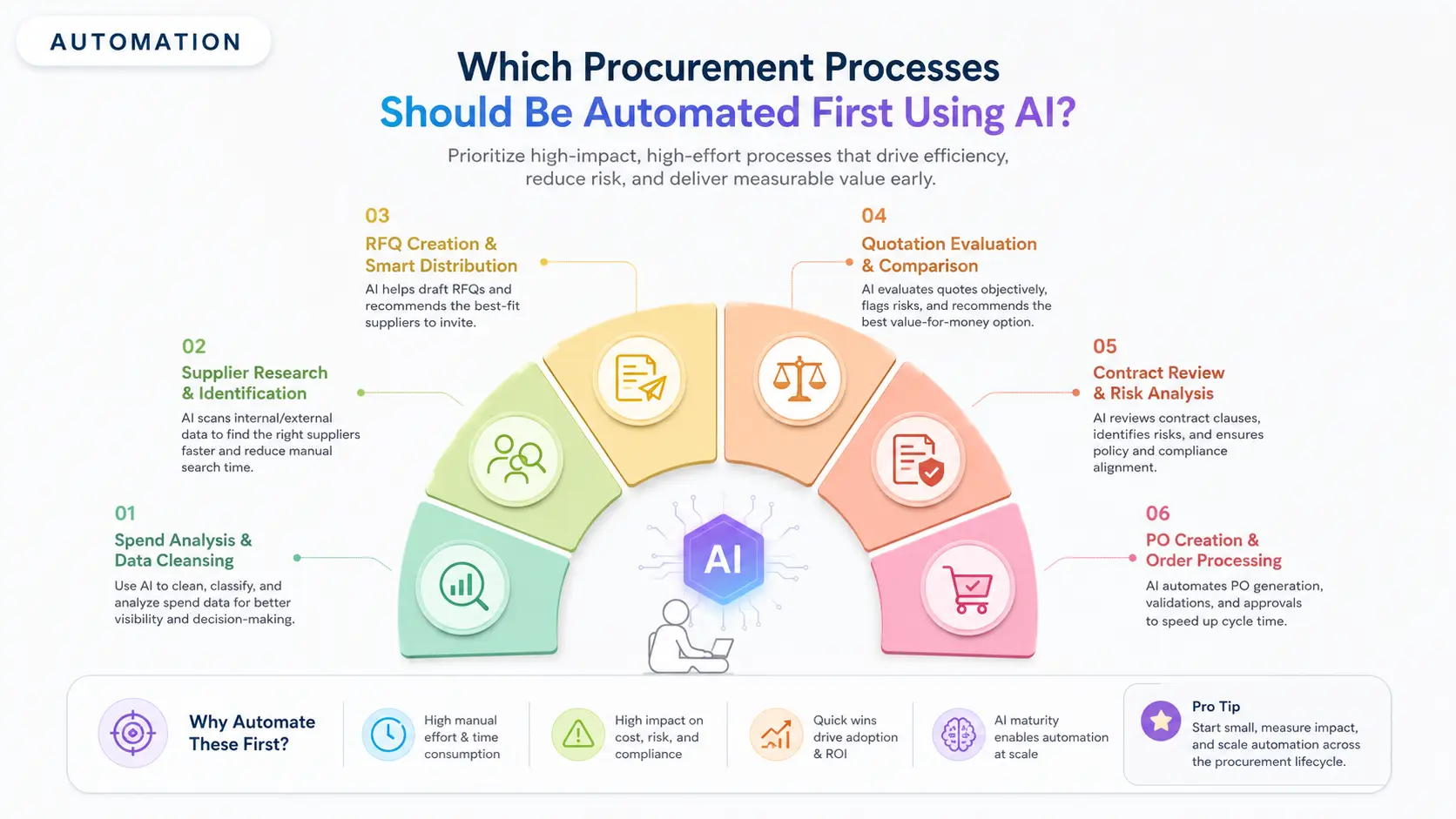
"Companies aren't failing at AI procurement because the technology doesn't work. They fail because they automate the wrong thing first."
Table of Contents
- Why Every Procurement Leader Is Asking This Question
- Why Sequencing Matters in AI Procurement Automation
- How to Decide Which Process to Automate First
- A Quick-Reference Prioritization Table
- Real Case Study: AI-Powered Invoice Automation
- Procurement Automation Across Industries
- Common Pitfalls to Avoid
- How Gezora.ai Helps Industries Integrate AI
- Measuring ROI: What to Track
- Frequently Asked Questions
- Conclusion: Start Small, Sequence Smart, Scale Strategically
1. Why Every Procurement Leader Is Asking This Question
"Which procurement process should be the priority for automation by artificial intelligence?" has emerged as one of the most frequently searched questions by chief procurement officers, heads of operations, and finance executives around the world. From being considered a paper-pushing activity, procurement has come to be recognized as an important value-adding activity, and this is all thanks to artificial intelligence.
The numbers don't lie. As stated by Deloitte's Global CPO Survey, 92% of CPOs are currently either implementing or evaluating generative AI solutions, and 22% of organizations will be investing more than $1 million annually on their AI procurement solutions. Research by Art of Procurement found that 94% of procurement leaders now use generative AI on a weekly basis, a 44 percentage-point increase compared to the previous year. And according to McKinsey, procurement teams that leverage AI-driven decision-making have lowered operational costs by 10% and select suppliers 30% faster.
But despite the optimism, very few companies have reached full deployment. Less than 4% of all companies that piloted generative AI in 2024 were able to implement it at enterprise scale. This isn't about technology, it's about the absence of a prioritized roadmap. Companies aren't failing at procuring automated AI solutions because the technology doesn't work; they fail because they automate the wrong thing.
This article explains which procurement processes should be automated first using AI, why sequence is important, and how to build an ROI-based automation strategy. You'll also see a real-life example of AI-enabled procurement automation in action.
2. Why Sequencing Matters in AI Procurement Automation
Procurement processes are not equally "automatable." Processes such as purchase order creation or invoice reconciliation are highly repetitive, rule-driven, and high-volume, making them natural early candidates for procurement process automation using AI. Other activities like supplier negotiation or category management contain heavy human elements that cannot yet be fully automated.
The proper ordering provides three concrete advantages to any organization exploring automated procurement:
- Faster, more visible ROI: By automating high-volume, low-complexity tasks first, tangible time and cost savings can be achieved within weeks, not years, building a strong case for future AI investments.
- Lower implementation risk: Starting with transactional processes, rather than sourcing processes, minimizes the risk if the AI makes a mistake while still learning.
- Stronger data foundations: Automating data-intensive operations such as spend classification and invoicing helps clean up procurement data, which then produces more accurate results in other AI applications, such as demand forecasting and supplier risk analysis.
With that in mind, let's look at how to find the right procurement processes for AI automation through a step-by-step process.
3. How to Decide Which Process to Automate First
Step 1: Map Your End-to-End Procurement Workflow
Before you automate anything, understand your complete source-to-pay process, from requisitioning and purchase order creation to supplier selection, contracting, invoicing, and payment. You'll soon find that most procurement workflows have 60-70% of their activity contained in a few transactional tasks. This is exactly the basis for a good procurement automation project.
Step 2: Score Each Process Against Four Criteria
Score your processes against the following criteria:
- Volume: How often do you have to do this task? High-frequency tasks, such as PO approvals and invoice verifications, save you the most time.
- Clarity of rules: Can the decision logic be clearly articulated (e.g., "accept the PO if the invoice matches the PO and the receipt")? More precise decision rules allow safer automation.
- Cost of errors: What is the current cost of potential errors? Manual data-entry errors in invoicing are frequent and costly.
- Data accessibility: Is the required data (contracts, invoices, vendor details) digital and easily accessible, or is it still locked in PDFs, emails, and spreadsheets?
Processes that score high on volume, rules, cost of errors, and data availability rank highest for AI procurement automation.
Step 3: Start With Transactional, High-Volume Processes
The scoring above consistently surfaces two processes that are the best place to start regardless of industry: PO management and invoice processing. Both involve many documents, are rule-based, and are performed multiple times every month.
- PO generation: AI can automate PO creation from approved purchase requisitions, approve POs against spending limits, and flag irregularities such as duplicate POs and price variances before submission.
- Invoicing and 3-way matching: AI-powered document processing can automatically extract line-item invoice detail, compare it against the PO and goods-received notes, and leave only exceptions (typically 10-30% of cases) for manual handling.
Step 4: Move to Spend Analytics and Supplier Risk Monitoring
Once transactional data is flowing smoothly through an automated pipeline, the next obvious step is AI-powered spend analytics and classification. Studies show that machine-learning-based spend classification can achieve up to 97% accuracy, giving procurement teams insight into where money is being spent, something that is very hard to do manually.
At the same time, AI-driven supplier risk monitoring constantly scans financial reports, news, shipping information, and compliance data for possible disruptions before they occur, a particularly valuable application for manufacturing, retail, and life sciences.
Step 5: Automate RFx Generation and Contract Review
With cleaner data and improved analytics in place, businesses are ready to leverage generative AI applications such as creating RFPs/RFQs, summarizing contracts, and identifying key terms or risk clauses. Procurement analysts report that RFP/RFQ creation and contract summarization are two of the most popular GenAI use cases, alongside spend analytics, among CPOs worldwide. While both still need manual sign-off, AI significantly reduces the time spent on them.
Step 6: Layer AI Into Strategic Sourcing and Negotiation Last
Strategic sourcing, supplier negotiation, and category development should be among the last tasks to involve automation, with AI used only as an assistant and not as a decision-maker. These functions rely on contextual elements and tradeoffs that are better handled by humans.
4. A Quick-Reference Prioritization Table
| Procurement Process | Automation Priority | Why It Ranks Here | Typical AI Tool Type |
|---|---|---|---|
| Purchase order creation & approval | Very High | High volume, repetitive, rule-based, low judgment required | AI procurement agent / workflow automation |
| Invoice processing & 3-way matching | Very High | Document-heavy, error-prone manually, clear matching rules | AI document/data processing |
| Spend analytics & classification | High | Large structured/unstructured data sets, clear ROI in visibility | AI KPI & analytics agent |
| Supplier risk monitoring | High | Continuous data streams, pattern detection well suited to AI | AI vendor management agent |
| RFx generation & contract review | Medium | Strong language generation use case, needs human sign-off | Generative AI / contract AI |
| Strategic sourcing & negotiation | Low (AI-assisted) | Relationship-driven, high judgment, best as human + AI | AI negotiation copilot / insights |
5. Real Case Study: AI-Powered Invoice Automation in Global Manufacturing
To see how this approach works in practice, consider the journey of a global manufacturing company that adopted AI to automate its invoicing.
The Challenge
Like many organizations, this firm received numerous supplier bills every month in different formats, including scanned versions, emails, and PDF documents. The invoices had to be manually matched against purchase orders and goods-receipt reports before payment could be processed. The procedure was time-consuming and error-prone, leading to payment disputes and deteriorating supplier relations.
The AI Procurement Automation Solution
Instead of embarking on a complete transformation of their procure-to-pay process, the company chose to automate invoice capture, verification, and 3-way matching. The system learned to read different invoice types and automatically reconcile line items from invoices with those in the POs and receiving documents, passing only the exceptions that needed human intervention.
The Results
- Cut processing time by half, releasing the accounts payable and procurement teams from repetitive tasks.
- Decreased the error rate by about 80%, reducing payment disputes and associated costs.
- Reinvested the time saved into negotiating with suppliers and driving cost savings.
This case demonstrates the central idea of this article: the firm did not begin with AI-based negotiation and strategic sourcing. It began with the process that was highest in volume, most rules-based, and most prone to errors.
The trend repeats industry-wide. A leading fast-food logistics network leveraged AI procurement analytics to fine-tune its supplier network, decreasing network distance by 25% and realizing an estimated €3.2 million in annual savings by identifying domestic suppliers. Retail giants have used AI-driven demand forecasts for procurement, reducing excess inventory by nearly 25%. In all of these examples, the same story emerges: AI delivered the quickest and surest results when first applied to high-volume, data-rich procurement processes.
6. Procurement Automation Across Industries
Implementing AI in procurement is not a universal approach; the ranking shifts somewhat based on the dynamics of each sector:
- Manufacturing & industrials: MRO spend optimization, predictive maintenance procurement, and supplier risk monitoring tend to generate early wins given the complex nature of raw-material and equipment supply chains.
- Retail & consumer goods: Demand-driven procurement, spend analytics, and supplier risk monitoring deliver early value where high transaction volumes and fast-moving inventory dominate.
- Healthcare & life sciences: Contract management, compliance monitoring, and supplier visibility are early objectives given the highly regulated nature of the business.
- Public sector: Compliance-driven document automation and vendor verification are often safer entry points due to regulation.
Regardless of the sector, the framework's reasoning still applies: start with structured, rule-based procurement activities, then move to analytics, contract management, and finally strategic sourcing.
7. Common Pitfalls to Avoid When Automating Procurement With AI
- Automating a bad process: AI speeds up any process you throw at it, even a bad one. Fix your processes first, then automate them.
- Neglecting data quality: The success of AI procurement solutions depends entirely on the accuracy of spend, contract, and supplier data. Poor data quality remains the biggest barrier to implementing AI in procurement today.
- Missing change management: No matter how good an AI procurement solution is, if procurement professionals don't know how to use its output effectively, no value is created.
- Automating strategic sourcing too soon: AI insights into negotiation and supplier management can help, but full automation is doomed without proper data and processes in place.
8. How Gezora.ai Is Helping Industries Integrate AI Into Procurement
Implementing the framework above calls for more than software; it calls for a partner that knows how to sequence automation based on each organization's individual procurement landscape. This is where Gezora.ai has carved a niche.
Gezora.ai provides AI automation solutions designed specifically for the procurement, HR, outreach, data processing, chatbot, and KPI performance needs of organizations.
- AI Procurement Agent: At the core of the Gezora.ai procurement solution is a smart vendor management and purchasing automation agent that assists with vendor evaluation, pricing negotiation support, and order placement, all aligned with the "automate first" goals described in this article.
- Industry-specific deployment: Instead of a general, all-purpose tool, Gezora.ai collaborates with manufacturing, retail, and service companies to understand their current procurement processes, determine which have the greatest impact, and customize the AI agent accordingly.
- Phased rollouts: Consistent with the step-by-step approach above, Gezora.ai usually begins with transactional automation, purchase orders, vendor analysis, and purchase decision-making, then moves on to more advanced vendor analytics and negotiation support.
- Cross-functional automation: Because procurement activities rarely occur in isolation, the Gezora.ai product line extends beyond procurement AI into AI-based data analysis and KPI performance tools, enabling end-to-end visibility instead of yet another point solution.
"Gezora.ai has completely revolutionized how we do vendor management because the AI knows what we want and helps make procurement decisions that we know are correct," said companies that adopted the Gezora.ai AI Procurement Agent in place of a manual spreadsheet process.
By combining an automation-first approach with industry-specific configurations, Gezora.ai positions itself not just as a software company but as an implementation partner that helps companies transform piecemeal AI experiments into a structured procurement automation roadmap.
9. Measuring ROI: What to Track as You Automate
An organized roadmap means little without a clear set of metrics. Here are the metrics to track as you implement each stage of your AI procurement automation strategy:
- Cycle time: How long does it take for a requisition to become a valid purchase order, and for an invoice to reach payment? AI can meaningfully reduce this within 60-90 days.
- Touchless transaction rate: The percentage of purchase orders or invoices processed without human intervention. Best-in-class procurement teams aim for 70%+ touchless processing on routine activities.
- Error and exception rate: Monitor the ratio of true exceptions flagged by AI against false positives, and fine-tune the process.
- Cost per transaction: Comparing the total cost before and after automation for POs and invoices may be the single most persuasive metric for securing further investment.
- Spend visibility: Measure what percentage of budget spend is automatically categorized and accounted for, versus what remains "uncategorized."
These measures also serve as governance checks: low touchless rates or high exception counts after deployment indicate the need to reconsider data quality or rule configuration.
10. Frequently Asked Questions on AI Procurement Automation
What is the easiest procurement process to automate with AI?
Order processing and invoicing are considered the simplest procurement activities to automate with AI because they are high-volume, repetitive, and governed by established approval rules.
Can AI fully replace procurement teams?
No. AI should be used as a collaborative tool for procurement experts, automating transaction-oriented and paperwork-intensive activities while delegating strategic sourcing, supplier management, and complex negotiations to humans.
How long does it take to see ROI from procurement automation?
Companies that start with transactional activities such as invoice automation tend to realize time and cost benefits within 60-90 days, while a full digital transformation takes years to yield benefits.
What industries benefit most from AI procurement automation?
Manufacturing, retail, healthcare and life sciences, and logistics benefit the most, due to their complex supply chains and high transaction and spend volumes.
11. Conclusion: Start Small, Sequence Smart, Scale Strategically
The question of which procurement processes to automate with AI does not have a single absolute answer, but there is a clear pattern of where to begin: high-volume, process-driven, data-heavy activities such as purchase orders and invoicing, then spend analysis and supplier risk, followed by contracts, before finally moving into strategic sourcing and negotiation.
Companies that adopt this sequence, rather than chasing the flashiest AI application first, end up with stronger returns, reduced risk, and better long-term adoption. Whether you are a CPO planning your first AI pilot or a head of operations scaling an existing deployment, the approach is the same: map your processes, score them realistically, and automate the highest-value transactions first before moving forward with a partner like Gezora.ai.
AI in procurement does not mean procurement specialists will be replaced. It means they will be liberated from tedious paperwork to do what AI cannot yet do: build relationships with suppliers and negotiate strategically.
Map your process, score it honestly, and automate the highest-value transactions first. That's how AI procurement actually scales.