Why Most AI Dashboards Look Good but Fail Businesses

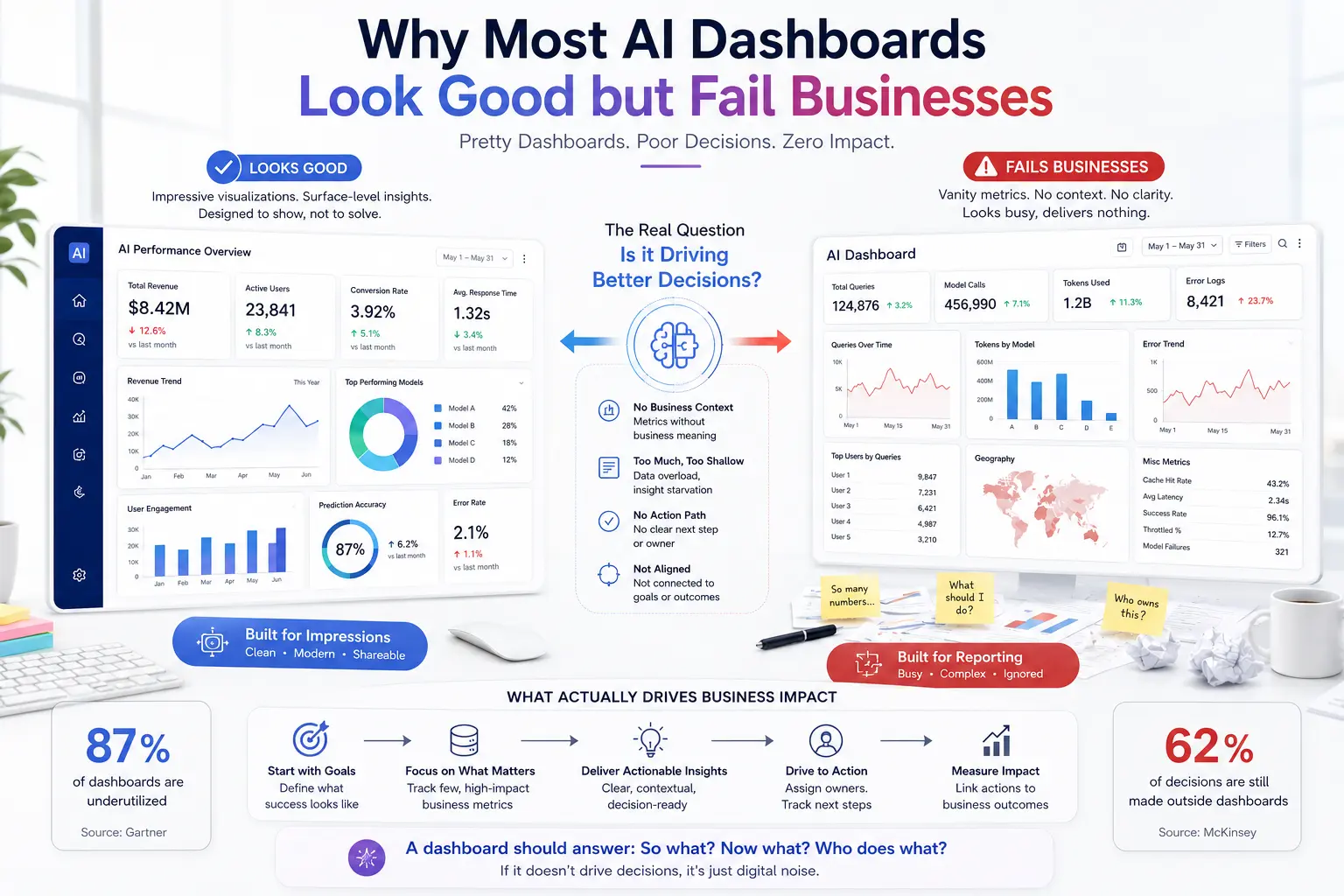
"The question every AI dashboard should answer is not 'What is happening?' but 'What should we do right now, and why?'"
Table of Contents
- The Seduction of the Beautiful Dashboard
- The Seven Core Reasons AI Dashboards Fail
- Real Case Study: A $4.2M AI Dashboard Failure
- What a Business-Grade AI Dashboard Actually Looks Like
- Five Questions to Ask Before Investing in AI Analytics
- The Future: From Dashboards to Decision Agents
- How Gezora.ai Turns AI Investment Into Real Outcomes
- Conclusion: Stop Buying Dashboards. Start Deploying Intelligence.
An under-the-radar crisis is developing within boardrooms, operations suites, and marketing teams globally. Billions of dollars have been spent on AI dashboards, BI tools, and analytics suites, but study after study confirms an uncomfortable fact: most of these solutions create no business impact. They dazzle in demos. They wow investors. They produce dazzling heat maps and KPI tiles that update in real time. But they do nothing to move the needle.
According to a 2024 Gartner study, more than 60% of enterprise AI initiatives fail to go beyond the pilot stage. Of those that are deployed, less than 30% create any tangible value in their first year. Meanwhile, IDC forecasts the global AI platform market will exceed $300 billion by 2026.
This article analyzes why AI dashboards fall flat for companies, not for technical reasons, but strategic and cultural ones, and what's really needed to build AI solutions that deliver real results. It walks through the reasons, provides a case study, and ends with how Gezora.ai solves this problem.
1. The Seduction of the Beautiful Dashboard
Attend any tech conference in 2025 and you'll be swamped with demos of AI dashboards. The visuals are beautiful. The animations are smooth. The data updates in real time. Executives line up to greet vendors who promise a 360-degree view of their business.
The problem lies precisely in that word: "view." A view is passive. Corporations don't need their data displayed in an aesthetically pleasing grid; they need to act on it, make decisions, generate revenue, save cost. That gap is exactly why the aesthetics-first AI dashboard has become its own main reason for failure.
1.1 Vanity Metrics vs. Value Metrics
Most AI dashboards are built on vanity metrics, figures that look good yet carry little operational value. Website visits, social media impressions, volume of data processed, and model accuracy levels impress people but say nothing about business performance.
Value metrics relate directly to outcomes: cost of acquisition, revenue per employee, customer lifetime value, defect-rate reduction, or inventory turnover. Unfortunately, most dashboard vendors optimize for the former because it's much easier to dramatize than the latter.
Key Insight: The question every AI dashboard should answer is not "What is happening?" but "What should we do right now, and why?"
1.2 The Demo-Reality Gap
An AI dashboard always looks great in a demo built from handpicked, perfectly cleaned data with preconfigured scenarios. Real business data is dirty, non-standard, and political. The moment a live dashboard connects to a company's actual data warehouse, things start falling apart.
Sales numbers are calculated differently in the CRM and the ERP. Marketing attribution doesn't reconcile with financial accounting. The clean picture from the demo becomes a mess of contradictions and debates in real life. This "demo-reality" discrepancy is one of the most common but rarely discussed reasons AI analytics fail to deliver.
2. The Seven Core Reasons AI Dashboards Fail Businesses
Across numerous AI implementations in different sectors, seven common failure modes recur. Recognizing them is the first step to building AI systems that work.
Reason 1: Designed for Analysts, Not Decision-Makers
Dashboards are typically built by data scientists and software developers whose natural inclination is to present a holistic view of the data. The result takes time to understand, patience to navigate, and effort to extract meaning from, and the people who actually need to act on it are usually too busy for that.
Reason 2: Lack of Contextual Intelligence
Data devoid of context is just noise. A dashboard showing a 15% drop in customer retention is alarming, but without context, seasonality, geography, a product change, the number is just overwhelming. Dashboards lacking contextual intelligence leave users scrambling between documents, emails, and institutional memory to interpret a single KPI.
Reason 3: No Integration With Existing Workflows
A successful AI dashboard must integrate with existing workflows. If it lives apart from core business processes, requiring a separate sign-in and a separate app, it will only be accessed occasionally. AI tools must surface information right where people already spend time, in their CRM, project management tool, email, or ERP.
Reason 4: Governance and Data Quality Neglect
A model is only as good as the data that trains it, and a dashboard is only as reliable as its data pipeline. For most companies, data quality is a secondary concern, recognized yet indefinitely deferred. Data discrepancies breed distrust, and once distrust sets in, it no longer matters how effective the tool actually is.
Reason 5: No Clear Action Layer
Most dashboards stop at insight. They show what's happening; some show why; very few show what to do next, and fewer still let you act on it immediately. This is the gap where ROI dies.
Reason 6: Over-Reliance on Historical Data
Many AI dashboards are just advanced reporting systems looking into the past, telling you how last quarter, month, or week went. But business value lies in predicting the future: who's about to churn, which point in the supply chain is about to fail, which market niche is about to boom.
Reason 7: Poor Change Management and Adoption Strategy
Technology doesn't change a business; people using technology do. Most AI dashboard deployments spend 90% of the budget on technology and 10% on people and process. The result: employees don't know why the software was bought, don't believe it helps them, and fall back on the same spreadsheets and gut feelings as before.
According to the McKinsey Global Institute, companies that pair AI tools with comprehensive change management programs are 2.5x more likely to report significant revenue impact within 18 months.
3. Real Case Study: How a Global Retailer Lost $4.2M on a "State-of-the-Art" AI Dashboard
Call this company "Retail," a multinational fashion retailer operating in 22 countries through over 600 stores. In 2022, Retail spent $6.8 million on a top AI-based retail analytics platform to streamline inventory optimization.
What They Bought
The solution centered on live inventory dashboards for all products and sites, an AI demand-forecasting tool trained on three years of sales history, a customer segmentation tool tied to their loyalty program, and a management command center with geographic visualization and predictive KPIs.
The demo was amazing. The vendor showed how the system could forecast a stockout in Jakarta two weeks ahead and launch campaigns at high-value customers showing churn signals. The deal was closed.
What Actually Happened
In the first six months, the operations team discovered a crucial flaw: the AI demand forecast was consistently off by 18-25% because the model was trained mainly on Western retail behavior. Seasonal peaks tied to Eid and Diwali weren't forecast accurately.
The attractive inventory dashboard had a critical flaw, it required a completely separate system from the existing ERP. Store managers, the target users, found the interface too complicated and relied on an operations supervisor for weekly summaries.
The customer segmentation tool identified 47 distinct customer groups, but marketing could only serve 4-5 at a time, lacking the capacity to build tailored campaigns for all of them simultaneously.
After 18 months, an internal audit found the platform had contributed to decisions that saved $1.6 million on markdowns, against a $6.8 million investment (excluding internal IT and training costs). The projected year-one ROI was 340%; the actual return was a net loss.
The Post-Mortem Findings
An external consultant identified four root causes: the AI model wasn't tailored to regional market trends; the tool wasn't integrated into the workflows of the people meant to act on it; there was no data governance strategy, causing inventory data discrepancies; and there was no change management plan, with 62% of target users receiving no training beyond a three-hour launch session.
Key Insight: Retail's story isn't exceptional, it's typical. The failure wasn't technology. It was the absence of a strategy to turn that technology into organizational behavior change.
What the Turnaround Looked Like
In year two, Retail partnered with an AI integrator to rebuild the program from scratch. The AI models were retrained on regional datasets and validated against regional holidays. The dashboard was embedded in the ERP interface so AI alerts reached store managers where they were comfortable. Campaign segmentation was capped at eight campaigns with automated personalization. A data governance council was established to maintain data quality and settle definitional disputes. Less than a year after the revamp, Retail realized a net gain of more than $9.1 million in savings and additional revenue.
4. What a Business-Grade AI Dashboard Actually Looks Like
With the failure modes outlined, here's what true business-level AI analytics involves. The difference is illuminating.
4.1 Outcome-First Design
Every metric, chart, alert, and report must link directly to a business objective it's meant to influence. Before writing a line of code or designing a visual, the team must ask: what decision will this enable? Who makes that decision? And what do they need to make it successfully?
4.2 Embedded Action Capabilities
The most effective AI solutions close the loop between insight and action. If the system detects that an important client hasn't purchased in 45 days and shows churn signals, it shouldn't just notify the user, it should offer to authorize an incentive, hand the customer to a relationship manager, or launch an automated re-engagement campaign with one click.
4.3 Contextual Explanations in Plain Language
AI output must be understandable to a layperson. If a predictive model recommends cutting stock in an SKU category, the dashboard should say, in plain terms: "Given your sell-through rate, seasonality, and supplier lead time, you have a predicted 22% excess in that category heading into Q4. Acting now saves roughly $340,000 on markdowns."
4.4 Workflow and System Integration
Business-oriented AI doesn't require employees to change their behavior; it's built into the systems they already use. That means an API-first approach, native plug-ins for ERP and CRM, and notifications through existing channels, Slack, Microsoft Teams, email, or mobile push.
4.5 Continuous Learning and Feedback Loops
AI models go stale. The world changes, customer behavior evolves, supply chains shift, and a model trained on last year's data grows less accurate every quarter. Business-grade AI solutions include automated retraining workflows, feedback loops that check whether predictions led to positive effects, and monitoring that alerts the team when a model starts to degrade.
5. The Five Questions Every Business Must Ask Before Investing in AI Analytics
Before signing any agreement with an AI analytics provider, insist on answers to these five questions. Vague responses are deal-breakers.
- What concrete business results have clients in our industry achieved with the platform, and may we contact references to confirm ROI?
- How does the platform integrate with our current ERP, CRM, and other systems, and what is the typical cost and timeframe?
- How is the AI model trained, and can it be tailored to our proprietary data?
- What change management and adoption support do you provide to help us adopt the system and trust its recommendations?
- What is the governance model? How does the platform handle data quality issues, conflicting data sources, and model deterioration?
If a vendor can't answer all five, walk away. Frontend sophistication is irrelevant to these answers. A fancy frontend built on poor strategy will fail; a simple frontend built on solid strategy will succeed.
6. The Future of AI Analytics: From Dashboards to Decision Agents
The next stage of business AI has already arrived. The passive visualization layer that requires a human to interpret it is being replaced by AI decision agents that observe, analyze, and act on the business's behalf in near real time.
This system doesn't wait for someone to sign in and notice a problem. It detects an anomaly, correlates it with historical and external data, evaluates the business impact, proposes solutions and consequences, and then either acts autonomously within predefined parameters or escalates to a human.
Early uses of agentic AI in supply chain management have proven effective in ways static dashboards can't match. One European logistics company recorded a 34% drop in emergency cargo charges after deploying an AI agent that rerouted shipments without human intervention based on weather, port congestion, and demand.
The shift from dashboards to agents won't happen overnight, nor should it happen without attention to governance, auditability, and human oversight. But the direction is unmistakable: the winners of the next decade will be the companies that move from seeing AI to doing AI.
7. How Gezora.ai Is Helping Industries Turn AI Investment Into Real Business Outcomes
Gezora.ai is built on the conviction that the gap between what AI can do and what businesses actually achieve with it is no longer about technology, it's about strategy and implementation.
We collaborate with organizations in manufacturing, retail, logistics, finance, and healthcare to build AI solutions measured not by how they look but by their impact. Here's how.
- Industry-specific AI model development: While generic solutions use one model across all industries, we build models trained and tested on the dynamics of yours. A demand forecast for a Southeast Asian fashion brand needs very different variables than one for a European grocery. We infuse domain knowledge into our data science, predictive maintenance models in manufacturing that predict failures weeks ahead within existing MES and CMMS systems, and credit risk intelligence in finance that adds contextual factors beyond credit scores.
- Seamless integration with existing systems: Every Gezora.ai implementation is API-first, with an integration mandate, not a replacement mandate. We connect with your ERP, CRM, WMS, HRIS, and operations systems so insights appear inside the software you already use. Companies that implement AI this way show 4x higher adoption than standalone dashboards. Our team integrates with SAP, Oracle, Microsoft Dynamics, Salesforce, and industry-specific systems to avoid the 12-month integration delay.
- Data governance and pipeline architecture: Governance isn't an afterthought; it's the core of every project. Before training models or building dashboards, we run an extensive data audit, sources, quality issues, conflicting definitions, ownership, then build automated pipelines with embedded quality checks. This is what keeps our AI systems trustworthy: when numbers are correct, consistent, and verifiable, users adopt them readily.
- Change management and capability building: We weight people and process as heavily as technology. Every project includes an adoption program, role-specific training, executive alignment sessions, power-user coaching, and performance evaluation. We identify and cultivate internal AI champions who sustain usage after our engagement ends. We measure success not by model accuracy but by the percentage of intended users actually using the system, the decisions made with AI, and their business impact.
- Continuous optimization and AI agent development: Our work doesn't stop at deployment. Every model includes continuous monitoring and retraining so performance improves rather than degrades. For clients ready to move from dashboards to agentic AI, we provide a structured AI Agent program that identifies the highest-value opportunities for autonomous decisions, builds a proper governance framework, and deploys agents that make decisions within set boundaries.
Gezora.ai result: Across our active client portfolio, the average time from AI deployment to first measurable business outcome is 6.2 weeks, versus an industry average of 7-9 months. Our clients don't wait for ROI. They experience it.
Industries Gezora.ai Serves
- Manufacturing: Predictive maintenance, quality defect identification, process planning.
- Retail & e-commerce: Demand forecasting, customer engagement, markdown optimization.
- Logistics & supply chain: Route optimization, supplier risk management, warehouse automation.
- Financial services: Credit risk modeling, fraud detection, regulatory intelligence.
- Healthcare: Patient outcome prediction, operations optimization, clinical decision support.
- Real estate: Property valuation, tenant behavior analysis, risk assessment.
If your business has invested in AI without the expected results, or you're planning your first AI investment and want to do it right from the start, Gezora.ai is the partner you need.
8. Conclusion: Stop Buying Dashboards. Start Deploying Intelligence.
The era of AI as a status symbol, a beautiful dashboard proudly displayed in the boardroom, is over. Companies that treated AI as a visual upgrade to their reporting systems have learned that visual upgrades don't create competitive advantage. Results do.
The companies that dominate their industries in the coming decade will build AI systems not to admire but to transform: systems that integrate seamlessly with business processes, explain decisions in plain language, connect insight to action, and continuously learn from real-world experience.
The gap isn't between what AI can do and what AI does. It's a gap in strategy, governance, adoption, and the redesign of work. Closing it takes more than a better vendor, it takes a different approach, one that starts with business impact before user experience and pretty dashboards.
That's where Gezora.ai comes in. Not with talk about great UI/UX, but with the hard work of actual AI integration.
Ready to close the gap? Talk to the Gezora.ai team about your AI transformation goals, no dashboard demos you've already seen, just a direct conversation about the outcomes you need. Visit gezora.ai.