Why Do Most AI Chatbots on Shopify Stores Feel Completely Useless?

"Chatbots have no value; conversational assistants create value. The difference is integration, not the AI model."
Table of Contents
- The State of AI Chatbots in eCommerce (2024–2026)
- The 7 Real Reasons Shopify AI Chatbots Fail
- Real Case Studies: When AI Chatbots Win and Lose
- What a Great Shopify AI Chatbot Actually Looks Like
- The SEO and Business Case for Getting This Right
- How Gezora.ai Is Redefining AI Integration for Shopify
- Conclusion: Integrate, Don't Just Install
You visit a Shopify store in search of a certain item. An animated chatbot bubble appears in the corner. "Hey there! Welcome. How can I assist you today?" You type a basic question: "Can you get me this shirt in size XL?" The answer comes back: "Sorry, but I'm not sure I got what you meant. Mind repeating your query?"
You close the chat window. You might never use the feature again in your lifetime.
That scenario happens millions of times each day in eCommerce stores around the world. No matter how many AI chatbot services exist for Shopify, from Tidio and Gorgias to custom-built ones powered by GPT, consumers find them frustrating, useless, or worse, annoying. But why?
In this article, we look at the core reasons most AI chatbots fail on Shopify storefronts, explore real examples, and find out how to design an effective conversational marketing chatbot that increases sales rather than hindering them. Finally, we uncover why Gezora.ai should be considered a new standard for modern eCommerce chatbots.
1. The State of AI Chatbots in eCommerce (2024–2026)
The marketplace for eCommerce AI chatbots is experiencing immense growth. According to Grand View Research, the worldwide chatbot industry was estimated at $5.4 billion in 2023 and is anticipated to expand at a CAGR greater than 23% through 2030. There are more than 4.6 million live Shopify stores, and many of them use some kind of AI chatbot system.
However, customer satisfaction ratings tell a very different story.
Key Statistic: According to the Forrester Survey of 2025, 68% of respondents dropped out of the chat window when the bot couldn't answer their query, and 43% said they felt frustrated after engaging with the chatbot.
That certainly speaks volumes about an industry that claims to "revolutionize the customer experience." So what gives rise to this huge gap?
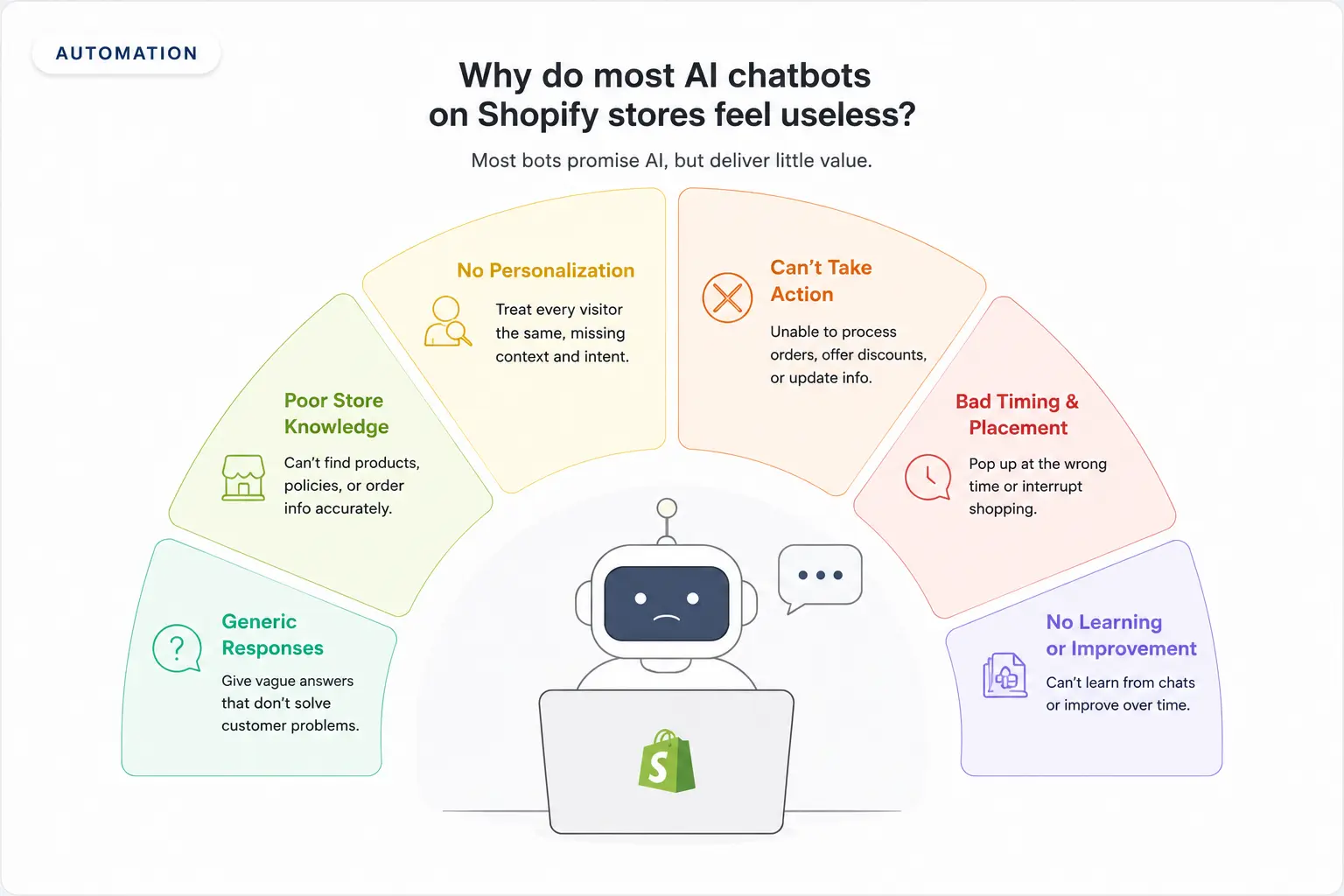
2. The 7 Real Reasons Shopify AI Chatbots Fail
Reason 1: They Are Trained on Generic Data, Not Your Store
The primary issue is obvious: these bots have no access to data from the store. Most generic AI chatbots are based on language models that can be customized very little.
If a customer asks, "What is your return policy on international orders?" the response is either very general or transferred to a human, rendering the bot pointless. A truly successful AI chatbot for Shopify needs to be intimately familiar with every aspect of the shop's operations.
SEO Keyword Insight: Fast-growing searches include "Shopify AI chatbot integration," "AI chatbot for Shopify," and "training an AI chatbot on store data." Merchant dissatisfaction with generic solutions is captured in these searches.
Reason 2: They Cannot Handle Real Conversational Context
Human dialogue is nonlinear. A customer might inquire about a product, ask for sizing information, then ask for a discount code, all in one chat. Rule-based and some AI-powered Shopify chatbots forget context after only two or three interactions.
This inability to manage flow and keep up with context results in the infamous "Sorry, can you please start over?" loop, sending your customer straight to a competitor. State-of-the-art models like GPT-4 and Claude can maintain context across many turns, yet most Shopify chatbot apps fail to use this capability due to cost or poor implementation.
Reason 3: Zero Personalization
Today's consumers are used to personalized experiences. Amazon suggests items based on browsing activity. Spotify creates tailored playlists. Netflix knows its users' viewing habits. Yet when these consumers interact with a Shopify chatbot, they receive the same cookie-cutter reply whether or not they've purchased from the store before.
For an AI chatbot to respond personally, it needs to know all sorts of information about the customer: purchase history, wish-list items, abandoned carts, geographic location, and more.
Reason 4: Poor Handling of Product Discovery Queries
One of the most valuable applications of a Shopify AI chatbot is product discovery, helping customers find the right product faster. Yet this is precisely where most chatbots fail. When a customer asks "I'm looking for a gift for a 40-year-old woman who enjoys hiking," the chatbot needs to discern intent and recommend appropriate products.
Most Shopify chatbots aren't integrated with a live search engine, so they can't look up the store, filter products, view inventory, and recommend related items. You end up with a chatbot that can answer questions and converse but can't help customers purchase, an absolute disaster for eCommerce.
SEO keywords: AI product recommendation chatbot Shopify, conversational commerce Shopify, AI shopping assistant for Shopify stores.
Reason 5: They Create Friction Instead of Removing It
Ironically, many Shopify bots complicate the purchase process instead of simplifying it. Unwanted pop-ups that interfere with buying, convoluted conversational flows that hide simple answers behind five clicks, bots that demand an email subscription before answering a basic query, all of these behaviors kill conversions.
The ideal conversational bot is invisible when not needed, extremely prompt when engaged, and utterly efficient at solving problems in as few steps as possible.
Reason 6: No Escalation Intelligence
No matter how good an AI chatbot is, some queries will be beyond it. The crucial question becomes: what next? Is there a smooth transition to a live agent with full conversation context, or does the bot simply say "I'll connect you to support" and drop the context?
Most Shopify chatbot solutions do the latter. This is a critical issue. According to Harvard Business Review research, consumers with poor handoff experiences are 67% less likely to make a purchase than consumers who never interacted with the bot at all.
Reason 7: Set-It-and-Forget-It Deployment
One of the least appreciated failure modes is neglect. Many Shopify sellers install a chatbot, spend a day setting it up, and leave it untouched. Product lines change, policies change, promotions come and go, yet the chatbot's responses remain outdated. Customers asking about expired promotions, or being told out-of-stock goods are available, instantly lose faith.
An effective AI chatbot requires constant maintenance: re-training cycles, updates, re-integration, and performance monitoring. These tasks prove too difficult for most small to mid-sized Shopify sellers.
3. Real Case Studies: When AI Chatbots Win and Lose
Case Study 1: The Failing Chatbot, Fashion Retailer "Luxe Thread" (Anonymized)
Luxe Thread is a mid-level Shopify fashion brand with annual sales of about $2.8M. In early 2024, it implemented a popular Shopify chatbot due to the excessive support tickets it faced during the holiday season.
Despite initial success (support tickets fell 22%), the situation soon deteriorated. The average satisfaction score for chatbot interactions was only 2.1 out of 5. The chatbot converted clients into buyers in just 1.4% of cases, versus 3.8% in human-operated sessions.
A later audit highlighted the key issues:
- It wasn't connected to live inventory, so it recommended out-of-stock products.
- It couldn't process returns, escalating 78% of the time and losing conversation context.
- It had no personalization, giving loyal customers a first-timer experience.
- Its knowledge base hadn't been updated in 90 days and listed three obsolete shipping policies.
As Luxe Thread's marketing director put it: "The chatbot didn't save us time; it created more work and irritated our most loyal customers."
Case Study 2: The Winning Chatbot, Home Goods Brand "Nest Craft" (Anonymized)
Nest Craft is a native Shopify home goods brand strongly focused on D2C commerce, with annual revenue of $6.1M. Fed up with the same challenges Luxe Thread faced, Nest Craft took a totally different path in late 2024.
Rather than installing a generic chatbot plugin, Nest Craft worked with an AI integration company to design a custom solution. Important technical specifications included:
- Live Shopify API connection: The chatbot received real-time inventory, price, and product attribute data.
- Customer-layer personalization: The bot collected previous-purchase information and made recommendations via an engine trained on historical Nest Craft sales data for logged-in users.
- Conversational search: A vector database built from their products let the bot recommend relevant items based on conversational input.
- Smooth escalations: Each conversation was recorded in detail, and escalations included a summary card overview.
- Monthly re-training: The model was retrained monthly using up-to-date product information, new FAQ entries, and resolved tickets.
The outcomes within the first six months were life-changing:
- Chatbot conversion rate increased from 1.1% (old chatbot) to 4.7%, outperforming their human-agent benchmark.
- Customer satisfaction in chatbot conversations: 4.4 out of 5.
- Support tickets dropped 54%, freeing employees for more complex problems.
- Average purchase size in chatbot conversations was 18% higher than non-chatbot sessions.
Key Takeaway: What separated Luxe Thread from Nest Craft had nothing to do with the AI model. It was data integration, personalization, and maintenance. Chatbots have no value; conversational assistants create value.
4. What a Great Shopify AI Chatbot Actually Looks Like
Drawing on the case studies above and a careful examination of top Shopify implementations from 2025 to 2026, five essential ingredients make up an effective AI chatbot.
1. Deep Store Integration
The bot needs real-time access to your store's product database, inventory, pricing, collections, and customer profiles. Without it, responses are guesswork. Shopify provides both the Admin API and Storefront API, but very few chatbot apps take advantage of them.
2. Context-Aware Conversations
Today's LLMs can hold context across several dozen interactions. An excellent Shopify chatbot makes full use of this, remembering everything the customer said, every product they checked out, and their preferences. This feature alone can lower conversation abandonment by more than 30%.
3. Intelligent Product Recommendations
Using semantic search and collaborative filtering, a well-performing chatbot can suggest suitable products from thousands of SKUs based on a plain-English description. That is conversational commerce, the technology Nest Craft used to raise average order value by 18%.
4. Multilingual and Multichannel Support
Shopify stores serve customers in many languages worldwide. A chatbot that only works in English is a major constraint. Multilingual AI chatbots, especially those based on transformer models trained on eCommerce data, offer enormous potential to expand capacity.
5. Analytics and Continuous Improvement
Each chatbot conversation is full of insights. The most successful implementations feed this information into a cycle of continuous improvement: analyzing knowledge-base gaps, identifying questions that cause escalations, and calculating conversion attribution per conversation. As a result, the chatbot evolves over time.
5. The SEO and Business Case for Getting This Right
A growing number of studies show a correlation between chatbot quality and organic ranking performance. Here's why. First, Google's Core Web Vitals increasingly favor stores with low bounce rates, long time-on-site, and high engagement, all metrics a good chatbot can positively influence.
Second, a bad chatbot experience leads to higher bounce rates and weaker engagement signals, which negatively impact organic search rankings. So the benefits of a well-designed Shopify chatbot go beyond support cost savings, they're directly connected to better CRO and CLV metrics.
High-value SEO keywords this topic targets: Shopify AI Chatbot | Best AI Chatbot for Shopify | AI chatbot for eCommerce | conversational commerce | Shopify AI customer support | AI shopping assistant | eCommerce chatbot integration | chatbot conversion rate Shopify | personalization chatbot Shopify | AI product recommendations Shopify
Business owners who combine chatbot excellence, SEO behavior patterns, and CRO have a significant leg up on competitors using cookie-cutter solutions.
6. How Gezora.ai Is Redefining AI Integration for Shopify and Beyond
While other companies offer you a service, Gezora.ai provides a partnership. As one of the fastest-growing AI integration experts for eCommerce, retail, and enterprise, Gezora.ai does something very different from its competitors.
Who Is Gezora.ai?
Gezora.ai offers AI-driven solutions through customized, end-to-end integration of AI within any business, regardless of industry: eCommerce platforms (Shopify and Shopify Plus), retail, logistics, healthcare management, and professional services. Instead of selling a SaaS tool, Gezora.ai ensures its solution is fully integrated within each client's ecosystem.
Gezora.ai's Approach to Shopify AI Integration
For Shopify merchants, Gezora.ai doesn't jump straight into deploying technology. The first step is a discovery stage to uncover the problems in a particular business's customer journey, so the AI solutions delivered are more focused and impactful.
A typical Gezora.ai Shopify AI stack includes:
- Fine-tuning custom language models using client product data, brand tone-of-voice instructions, and previous ticketing data.
- Real-time connection to the Shopify API, including inventory, pricing, customer data, and order management.
- Semantic search via vector embeddings, allowing natural-language search across products.
- Personalization that uses CRM data and Shopify customer data to tailor each conversation.
- Full conversation context in human escalations.
- A post-deployment dashboard with conversation-level attribution.
Working Across Industries
Gezora.ai's AI integration work extends beyond Shopify into adjacent industries where the same problems of generic, isolated AI software disrupt business processes.
- Retail & wholesale: Gezora.ai has helped retail brands build AI solutions that integrate physical and digital inventory for a coherent customer experience across both channels.
- Logistics & supply chain: LLM-based dispatch assistants integrated with real-time shipment monitoring and ERP systems have cut freight-query time by over 60%.
- Healthcare administration: HIPAA-compliant AI intake and scheduling assistants reduce administrative workload while keeping sensitive information secure.
- Professional services: AI knowledge-management assistants integrated with documentation databases, past-case libraries, and regulatory documents have been deployed for law firms, accountancy bureaus, and consultancies.
The Gezora.ai Philosophy: AI That Actually Works
"By far the most significant issue in enterprise AI right now is the gap between what vendors say they do and what businesses actually receive," explains the Gezora.ai team. "Closing this gap doesn't come through product sales, but through system design and development that fits how a business works."
This mindset shows in Gezora.ai's client retention rate, its focus on delivering ROI from day one, and its continued optimization support after the initial sale. For Shopify store owners frustrated by chatbots that promise conversational commerce but deliver pre-recorded annoyance, Gezora.ai is a completely different breed of technology company.
Curious about integrating an AI system into your Shopify storefront? Visit gezora.ai and schedule a no-obligation discovery session to learn how the Gezora.ai team of AI engineers and eCommerce specialists can help you succeed.
7. Conclusion: The Future of AI in Shopify Belongs to Those Who Integrate, Not Just Install
AI in eCommerce is no myth. It's real. Conversational shopping, personalized product discovery, and always-on intelligent support are real too, and they've been implemented successfully.
But doing it effectively involves more than installing a chatbot plugin and expecting it to perform. Effective use of AI chatbots requires thorough integration into the existing store structure, continuous optimization, and an approach where the customer dictates the actions and responses.
The AI chatbots used by many Shopify stores are pointless because they lack relevance and integration. Successful businesses will be those that see AI not as an add-on feature but as a strategic infrastructure investment. Done right, such a chatbot becomes one of a company's key growth engines.
The secret of a good chatbot doesn't lie in its technological capabilities. It depends on how intelligent the integration is, how relevant the information collected about users is, and whether there's a high-quality partnership behind it.
Integrate, don't just install. That's the difference between a chatbot customers ignore and an assistant that drives growth.