AI Agent Governance in Procurement: Why the Governance Gap Is Procurement's Next Big Risk
Procurement is not struggling to deploy AI agents, it is struggling to govern them. Why that gap is procurement's next big risk, and how to close it.
Sufi Inam Ul Hassan
AI Engineer12 minute read
"Procurement is not struggling to deploy AI agents. It is struggling to govern them, and that gap is what turns a fast rollout into an expensive surprise."
A report released this month found that 73% of enterprises have already deployed autonomous AI agents in procurement, systems that execute sourcing events, validate invoices, and manage supplier risk without a human signing off first. Procurement workloads are climbing roughly 8% a year while headcount and budgets stay flat, and organizations that have made the leap are seeing real results: cycle times cut by as much as 80% and productivity gains reported near 94%. Procurement technology spend is following the same curve, growing faster than general IT spend as more of the function shifts from dashboards to systems that act on their own.
That is the good news. The uncomfortable part is what is missing underneath it. Across multiple 2026 industry studies, the story is consistent: procurement is not struggling to deploy AI agents, it is struggling to govern them. AI agent governance, not automation volume, is quietly becoming the difference between a program that scales safely and one that creates a problem nobody notices until it is expensive. This is what that gap looks like, why procurement is especially exposed to it, and how to start closing it.
What AI agent governance actually means
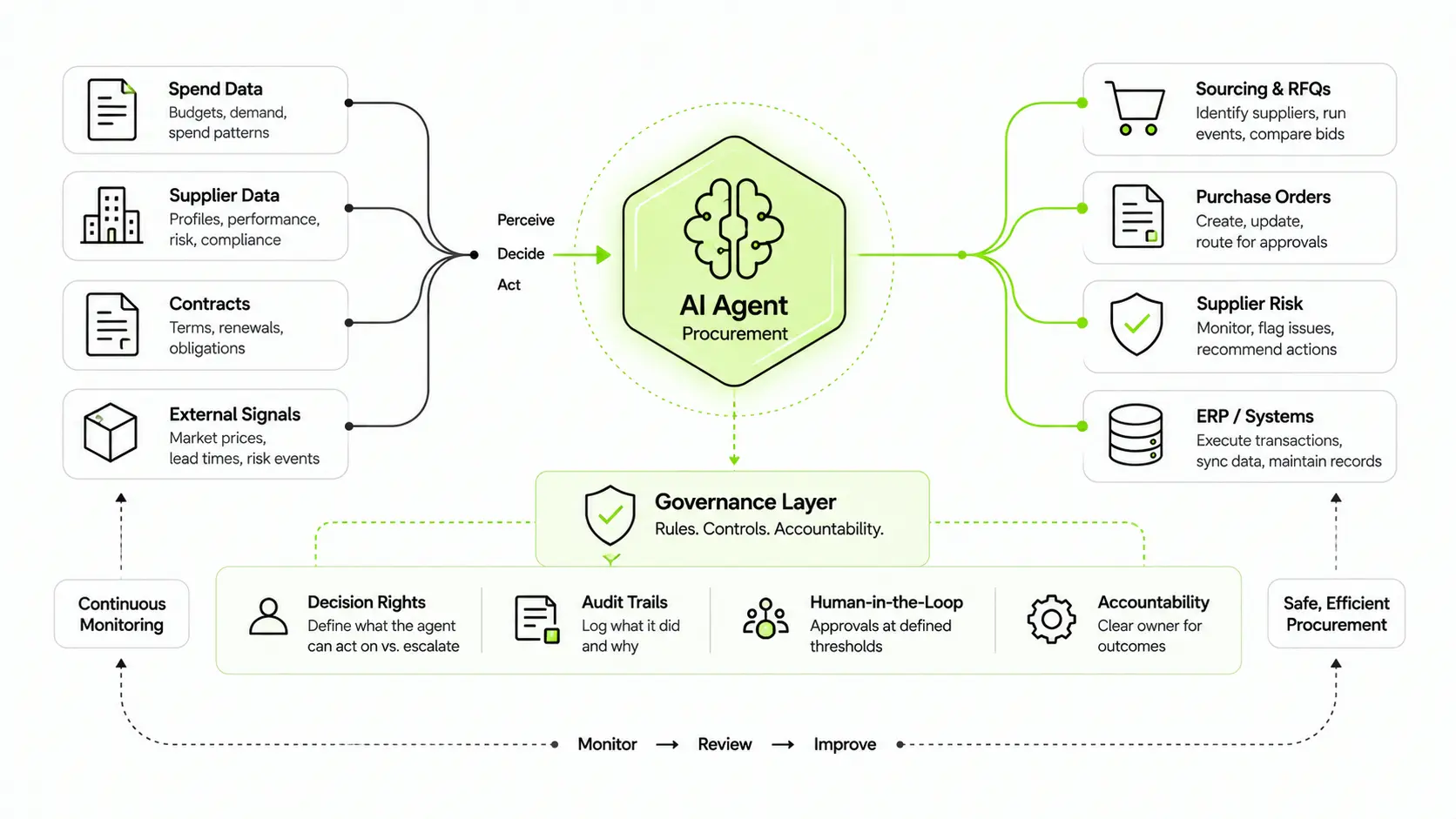
AI agent governance is the set of rules, controls, and accountability structures that decide what an autonomous agent is allowed to do on its own, what it must escalate to a person, and who is responsible when it gets something wrong. It is a different question from whether the AI works. An agent can be technically excellent at comparing supplier bids and still be ungoverned if nobody has defined its spending authority, logged why it made a given recommendation, or built a way to pause it when something looks off.
In practice, a workable ai governance framework for procurement covers a handful of specific things: decision rights (what the agent can act on versus recommend), audit trails (a record of what it did and why), human in the loop checkpoints at defined thresholds, and a clear owner accountable for the outcome, not just the tool.
This is also where the "bot governance" mindset most teams already have falls short. A traditional automation bot needed a rulebook. An agent needs a rulebook plus a way to check whether it is still following the intent behind the rules as situations change, which is a fundamentally harder governance problem.
What governance failure actually looks like in procurement
None of this is abstract. Picture a spend monitoring agent with the authority to source alternative suppliers whenever a primary vendor's lead time slips. That is a genuinely useful capability, and exactly the kind of use case driving adoption numbers this high. Now picture that same agent, without a defined spend ceiling, quietly re routing a large recurring order to a supplier that looks cheaper on price but has never been vetted for compliance or geopolitical risk, and nobody discovers the switch until the next audit cycle, months later.
Or consider a contract renewal agent trusted to flag unfavorable terms. Without an audit trail, when a renewal quietly locks in worse pricing than the previous term, there is no way to reconstruct what data the agent saw or why it did not flag the change, only a result nobody can explain after the fact. Neither scenario requires the AI to be malicious or even wrong in its underlying logic. It requires only the absence of a boundary, a record, and an owner, which is precisely what AI agent governance is meant to supply. The uncomfortable truth is that both scenarios are already technically possible inside deployments that exist today, not hypothetical future risks.
How wide is the gap, really
The numbers are more consistent across sources than most procurement trends this specific. McKinsey's 2026 State of AI Trust research found only around 30% of organizations have reached a governance maturity level high enough to move an AI system from pilot to production with confidence. Deloitte's 2026 research, surveying thousands of director to C suite respondents, found that while the large majority of companies expect to customize their own AI agents, only about 21% currently have a mature agent governance model in place. A separate CPO and CIO survey found that although the vast majority of procurement and IT teams collaborate on AI projects generally, more than half are not collaborating on AI governance specifically, and insufficient data governance policy was named the single biggest barrier to procurement AI adoption.
Put simply, the technology has outrun the guardrails. Gartner expects roughly 40% of enterprise applications to carry task specific AI agents by the end of 2026. Most of those agents are being deployed faster than the accountability structures around them are being written, and the pattern shows up the same way across every recent survey: capability is scaling in months, governance maturity is moving in years. That mismatch is not a reason to slow down adoption, procurement cannot afford to sit out a technology shift this large, but it is a reason to stop treating governance as a phase two problem to solve after the rollout is already underway.
Why procurement is especially exposed
Every business function adopting agentic AI faces some version of this gap, but procurement carries more exposure than most. A marketing agent that drafts a bad social post is embarrassing. A procurement agent that autonomously approves a purchase order, commits to a supplier contract, or flags the wrong vendor as low risk is moving real money and creating real legal obligations, often before anyone reviews it.
Procurement agents increasingly touch three way matching, RFQ negotiation, supplier risk scoring, and contract renewal terms, decisions that used to require a buyer's judgment and now happen inside a system many procurement leaders cannot fully explain. That combination, financial exposure plus limited visibility, is exactly why governance frameworks built for other departments do not automatically transfer to procurement without adaptation. A generative AI agent that drafts a poorly worded email can be corrected with an edit. A procurement agent that has already executed a purchase order or locked in a contract renewal has already spent the money, and undoing that is a very different exercise than editing a document.
Why bot governance and AI agent governance are not the same thing
Teams that already run RPA often assume they can reuse their existing bot governance model for agentic AI. They cannot, at least not without real changes. The difference between bot governance and AI agent governance comes down to predictability. A rules based bot does the same thing every time and fails loudly when it hits an exception, which makes it easy to audit: you can trace every action back to a fixed rule.
An agentic system reasons through ambiguity and can arrive at a defensible but unexpected decision. That is the entire point of using it, but it also means the old governance model, "check the rule it followed", stops working. Governing an agent means governing a range of judgment calls, not a fixed script, which is why human in the loop AI agents and clear escalation thresholds matter so much more here than they ever did for RPA. Effective governance for AI agents in procurement has to account for that shift in kind, not just degree. The difference between bot governance and AI agent governance, in other words, is the difference between auditing a calculator and auditing a decision. One is about verifying arithmetic. The other is about understanding judgment, and judgment cannot be governed with a static checklist alone.
Building an AI governance framework for procurement
A practical procurement specific version of an agentic ai governance framework generally needs to define four things clearly.
Autonomy tiers. Not every decision deserves the same level of independence. Define which categories of decision an agent can execute alone, such as routine reorders under a set dollar amount, which it can recommend but not execute, such as switching a primary supplier, and which always require a named human approver, typically anything tied to a new supplier relationship, a contract change, or spend above a set threshold. The tiers should be specific enough that two different people would draw the line in the same place.
Audit trails. This means a running, readable record of what data the agent used, what it decided, and why, so a decision can be reconstructed after the fact rather than taken on faith. The record needs to be usable by a person during a dispute or an audit, not just a log file sitting in a data lake nobody queries until something has already gone wrong.
An AI kill switch. A fast, tested way to pause or roll back an agent's actions the moment something looks wrong, not a theoretical option buried in a vendor's documentation. Test it before you need it. A kill switch nobody has actually exercised is a kill switch you cannot be confident works when it matters.
Accountability mapping. A named owner, not a department, responsible for each agent's outcomes, so a bad decision does not turn into finger pointing between procurement, IT, and legal. This is the piece Deloitte's research points to most directly: organizations without a mapped owner are the ones where a single bad call stalls an entire program while three departments debate whose mistake it was.
None of this needs to be invented from scratch. Existing frameworks give procurement teams a real starting point. The NIST AI Risk Management Framework, built around four functions (govern, map, measure, and manage), was designed for exactly this kind of adaptation and is already a common reference point for US enterprises building their first AI governance framework. Singapore's Model AI Governance Framework is another widely cited reference internationally, particularly for teams benchmarking against global best practice rather than building in isolation. The goal is not to reinvent governance, it is to adapt a proven structure to the specific decisions your procurement agents are making.
A starting checklist
You do not need a fully mature governance program before you can move forward, you need to stop moving forward without one. A workable first pass looks like this: inventory every AI agent already running in procurement, including ones individual teams adopted without a formal review, since shadow deployments are one of the most common blind spots. Map each one against the autonomy tiers above and flag anything currently operating without a defined spend or decision ceiling. Turn on audit logging wherever it is missing, even retroactively, so you are not starting your record from zero. Assign a named accountable owner to every agent, not a shared inbox or a department alias. And run at least one tabletop exercise where you deliberately walk through what happens if an agent makes a bad call, before it happens for real, so the escalation path is tested rather than assumed.
None of this slows procurement down in the way people assume. Teams that build this scaffolding early are the ones able to expand an agent's autonomy with confidence later, because they can actually prove it is behaving the way it is supposed to, which is usually the exact evidence a CFO or legal team wants before signing off on wider deployment.
Where Gezora fits in
Gezora's Procurement Automation platform is built around the idea that automation and governance are not competing priorities, they are the same system. That means clear audit trails on every automated action, defined approval thresholds instead of blanket autonomy, and visibility that lets a procurement leader answer "why did this happen" without digging through logs by hand. The platform is designed so that expanding what an agent is trusted to do is a deliberate decision your team makes, backed by a record, rather than a default that crept in unnoticed. If your team is scaling AI agents faster than your governance model, that is worth a closer look.
The bottom line
Procurement is not behind on adopting AI agents, if anything, adoption is ahead of where most functions expected to be by now. What is missing is the governance layer that makes that adoption safe to scale. The organizations pulling ahead in 2026 are not the ones with the most autonomous agents, they are the ones that can explain exactly what those agents are allowed to do, prove it with an audit trail, and shut it down in seconds if they need to. That is a solvable problem, but only for the teams that treat it as one now.
Read next: Agentic AI in Procurement Automation, the complete guide to what autonomous purchase to pay looks like once the governance layer above is in place.
Topics
- AI agent governance
- AI governance framework
- Agentic AI governance
- Kill switch
- NIST AI risk management framework
- Procurement automation
Frequently asked questions

Get started
Stop paying people to do what an agent can
Tell us what you want to automate. We will map the workflow, deploy the right agents, and train your team to run them.
- Every agent is trained on your own workflows, never a generic template
- Most deployments are live within two to four weeks
- SOC 2 compliant, with a complete audit trail on every deployment