
Conversational AI for Customer Service in 2026: Why Customers Skip Chatbots and What Actually Works
Only 7% of customers used a company chatbot in their last service interaction. Here is what conversational AI for customer service needs to win them back.
Sufi Inam Ul Hassan
AI Engineer12 minute read
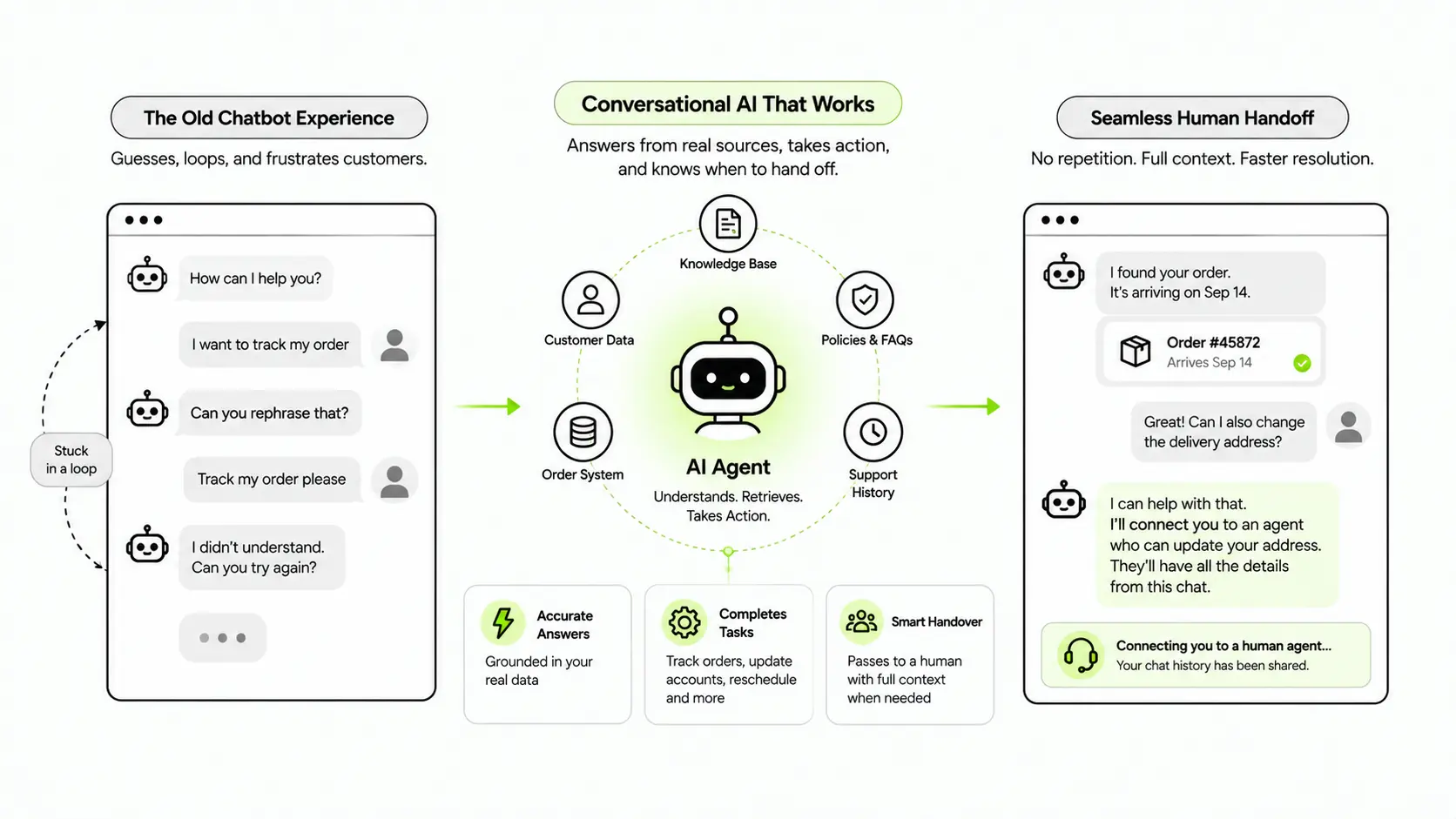
"Customers did not reject conversational AI. They rejected chatbots that guessed, trapped them in loops, or explained what a real agent would have just done."
Customer service teams have spent heavily on chatbots, and customers have quietly walked around them. In a Gartner survey of 3,566 customers published in September 2026, 49% said they would have been willing to use a chatbot if the company had offered one, yet only 7% actually used one during their most recent service interaction, and just 27% would try a chatbot again after a negative experience. The same research found customers about three times more likely to turn to third party tools such as ChatGPT, Gemini or Copilot than to the company's own chatbot.
That gap is the real story in conversational AI for customer service this year. The models can read intent, answer in plain language and complete tasks. Customers are reacting to what they already lived through: bots that guessed, looped, or stood between them and a person, and every failed conversation shrinks the audience for the next one.
This guide covers what the technology is, why adoption stalled, the design rules that bring customers back, and the numbers that tell you it is working.
What is conversational AI for customer service?
Conversational AI is software that understands what a customer types or says in everyday language, works out what they want, and responds the way a capable agent would. It runs in website chat, messaging apps, help centers and, increasingly, on the phone. Three components do the work: natural language processing to read the message, a large language model to write the reply, and a connection to your own knowledge and systems, usually through retrieval augmented generation (RAG), so the reply reflects your policies and your customer's account.
Three kinds of tools share the label, and it pays to know which one you are buying.
Rule based chatbots follow decision trees and keyword matches. They are predictable and cheap to run, and they fail the moment a customer phrases something in a way the script did not expect.
AI chatbots use generative AI to understand free text and write natural answers, ideally grounded in an approved knowledge base. Most chatbots for customer service launched in the last few years sit here, and so do most generative AI customer service tools on the market.
AI agents go a step further and take actions in connected systems, such as rescheduling a delivery or updating an account, inside limits you set. A customer service AI agent is where most vendors are heading, and agentic AI for customer service is the phrase you will find on nearly every 2026 roadmap.
The failure modes differ by type. A rule based bot frustrates people by misunderstanding them. A generative bot can fail more quietly, by answering fluently and wrongly. Our companion guide to the types of chatbots covers the full comparison, including where virtual assistants and voice bots fit.
The adoption gap in numbers
Nobody can accuse service leaders of moving slowly. In a Gartner survey, 91% of service and support leaders reported pressure from executive leadership to implement AI in 2026. Separate Gartner research found that service teams put a median of 12% of their 2025 budget into AI, the highest share of the ten business functions assessed, while only 24% of service and support leaders could show positive financial returns across their AI use cases.
Customer behavior explains most of that shortfall. According to the same Gartner study, use of third party GenAI tools during service interactions nearly doubled in a year, while use of company provided chatbots has stayed statistically flat since 2022. Customers are happy to use AI. What they avoid is the version many companies shipped.
Gartner calls the result a leaky bucket. Because so few customers come back after a bad experience, a chatbot that fails often keeps losing users even after it improves. Reach makes this worse. A bot that attempts everything and resolves half of it loses customers faster than one that resolves a narrow set of requests every time.
That matters because the benefits of AI in customer service, from instant answers at any hour to consistent policy answers and agents freed from repetitive tickets, only show up in your numbers when customers choose the channel. Adoption sits upstream of every other metric you will report.
Why customers give up on chatbots
The disadvantages of chatbots in customer service cluster into three failures, and Gartner's list of reasons customers pick another channel reads like a post mortem: the bot misunderstood the issue, gave generic information, or made it harder to reach a person.
The bot guesses
Language models are fluent by design, and fluency hides uncertainty. When a bot has no approved source for a question, it can still produce a plausible answer, and a plausible wrong answer does more damage than "I don't know" because the customer acts on it. Generic answers are the milder form of the same problem: accurate in general, useless for this customer's order.
The bot traps
Many deployments were scored on containment, the share of conversations that never reached an agent, so they were built to keep people in. Customers noticed. According to Gartner, 87% of customers say access to a human agent is essential when a company uses GenAI for service, and customers who are pushed through several failed AI attempts before reaching a person are less likely to use the tool again.
The bot explains when it should act
Customers now expect AI to do things. Gartner found that among customers who use GenAI, 58% have used it to complete a task on their behalf, rising to 74% in B2B. A bot that answers "change my delivery date" with a link to the delivery policy has replied, and it has still failed.
These are the disadvantages of AI in customer service that show up in complaint logs. A better model alone fixes none of them, because each one is a design decision.
Five design rules that bring customers back
Gartner's prescription is to put reliability ahead of reach: start with issue types that have a proven high resolution rate, tell customers clearly what the bot can do, and expand scope only after performance is reliable. Turned into chatbot best practices, that becomes five chatbot design decisions you make before launch, each aimed at one of the failures above.
1. Answer only from sources you approve
A knowledge base chatbot retrieves passages from your documentation, FAQs and policies, writes its answer from them, and shows the source beside the reply. Every source needs an owner, out of date pages need to leave the answer scope, and internal policy documents can inform an answer without being quoted to customers.
Retrieval reduces errors without removing them. When Stanford researchers evaluated commercial legal research tools built on RAG in 2024, the tools still hallucinated between 17% and 33% of the time. In the Air Canada case, the chatbot's own answer linked to the airline's bereavement policy page, and that page contradicted what the bot had just told the customer. Citing a source and staying faithful to it are two separate checks. You need both.
2. Let the bot say "I don't know"
Set a confidence threshold below which the draft answer is held back. Keep a list of restricted topics, such as legal claims, medical advice and refunds outside policy, that the bot declines politely every time. A bot that admits a gap and routes the question keeps trust. A bot that improvises spends it.
3. Hand off with the full context
When confidence drops, move the conversation into a real support queue with the transcript, the detected intent and everything the customer already provided. The test is simple: the customer never repeats themselves.
4. Complete the task, inside limits you set
Connect the bot to the systems behind routine requests, such as order management, scheduling and CRM, through approved integrations only. Let it reschedule a delivery or resend a confirmation, write the result back into the chat, and hold anything outside policy for a person. That is the practical meaning of an AI agent for customer service: bounded actions, a full audit trail, and a decision boundary set through agentic workflow design before anything goes live.
5. Start narrow, test hard, expand on evidence
Pick a handful of high volume intents with clear answers. Before launch, test the chatbot the way customers will break it: misspellings, two questions in one message, angry phrasing, and requests just outside policy. Go live on that scope, tell customers what the bot handles, and add intents only when resolution and satisfaction hold.
Chatbot vs live chat, design for both
The chatbot vs live chat debate assumes you have to choose. Customers have already chosen both: automation for simple, fast answers and a person for everything else, ideally in the same window. Regulation is moving the same way. Gartner predicts that by 2028, rules guaranteeing the right to talk to a human will raise assisted service volume by 30%, so a missing human option is turning into a compliance problem on top of a satisfaction problem.
A good hybrid lets the bot handle intake and routine resolution, then passes the conversation to live chat agents with the thread attached, so customers experience one continuous conversation.
It also answers the question of whether AI will replace customer service, at least for the next few years. Gartner's April 2026 survey found that 85% of service leaders are expanding human agent responsibilities, and only 31% have implemented or are planning layoffs in response to AI through early 2027. The work left for people is harder, more emotional and more valuable, which is exactly the work a well designed customer care chatbot should route to them.
Hallucinations, liability and AI disclosure in 2026
Two decisions settled who owns a chatbot's mistakes. In Moffatt v. Air Canada, a Canadian tribunal held the airline liable for its chatbot's wrong answer on bereavement fares and rejected the argument that the bot was responsible for its own words. In May 2026, Germany's Higher Regional Court of Hamm held a medical company liable for false statements its chatbot made about the qualifications of its doctors. These are the AI hallucination cases every support leader should know, and they point the same way: what the bot says, the company said.
Disclosure is now a legal duty in the EU as well. Article 50 of the AI Act applies from 2 August 2026 and requires AI systems that interact directly with people to be designed so those people are informed they are dealing with AI, unless that is obvious. The Digital Omnibus that delayed other parts of the Act left most of these transparency duties, chatbot disclosure included, on the original date.
Knowing how to prevent AI hallucinations from turning into liabilities comes down to a short list of controls:
- Ground every answer in an approved, owned source and show that source.
- Check each draft against its source before it sends, and hold low confidence answers.
- Keep a restricted topics list the bot never answers.
- Disclose the AI in the first message and keep a complete, exportable log of every conversation.
- Review escalations and flagged answers every week, and fix the source when the source is wrong.
How to measure a customer service chatbot
Most dashboards still lead with containment or deflection, the share of conversations that never reached a person. Both reward the trapping behavior customers dislike. These five measures show whether customers got what they came for:
| Metric | What it tells you | Warning sign |
|---|---|---|
| Verified resolution rate | Issues actually solved, confirmed by the customer or by no repeat contact | Containment rising while resolution stays flat |
| Repeat contact rate | Customers who return through another channel within a week | Bot "resolutions" followed by phone calls |
| Bot CSAT against agent CSAT | Satisfaction with AI handled versus human handled conversations | A gap that widens month on month |
| Handoff quality | Share of escalations where the agent did not need to ask again | Customers repeating order numbers |
| Adoption rate | Share of eligible customers who choose the bot | Flat usage while site traffic grows |
Track cost per resolution too, and expect it to move. Gartner forecasts that GenAI cost per resolution will exceed $3 by 2030, higher than many offshore human agents, so the business case has to rest on resolution quality and customer lifetime value more than on cheap replacement of people. It is the same trap as treating AI usage as a KPI: activity is easy to count and says little about value.
What comes next for AI in customer service
The future of AI in customer service is agentic, bounded and blended with human teams. Gartner predicts that by 2029, agentic AI will autonomously resolve 80% of common customer service issues without human intervention. Reaching that depends on the rules above, because autonomy raises the cost of a wrong action the same way fluency raised the cost of a wrong answer.
Three extensions are already practical. Voice comes next: an AI voice agent for customer service applies the same grounding and handoff rules on the phone, where Gartner notes customers still go when they need to transact, reach account details or resolve complex issues. Internal support is the easiest win: an IT helpdesk chatbot that answers policy questions, resets access and logs tickets follows the same design with a friendlier audience. And AI customer self service is moving into the product itself.
Conversational AI for customer support will keep getting more capable. The companies that gain from it will be the ones whose customers trust it enough to open the chat.
Where to start
Pull last quarter's tickets and find the ten intents with the highest volume and the clearest answers. Confirm each one has a current source with an owner. Decide what the bot may do on its own, what it must hand off and what it must never touch, then launch on that narrow scope with disclosure in the first message and verified resolution as the headline metric. That is how conversational AI for customer service earns the second visit most chatbots never get.
If you want to see that setup running on your own knowledge base, Gezora's AI chatbots answer from approved sources with citations and hand off to your team with the full conversation attached.
Topics
- Customer service AI agent
- Chatbots for customer service
- Chatbot vs live chat
- Chatbot best practices
- Generative AI customer service
- AI hallucination prevention
Frequently asked questions

Get started
Stop paying people to do what an agent can
Tell us what you want to automate. We will map the workflow, deploy the right agents, and train your team to run them.
- Every agent is trained on your own workflows, never a generic template
- Most deployments are live within two to four weeks
- SOC 2 compliant, with a complete audit trail on every deployment