
HR Automation Tools in 2026: What to Automate, What to Verify, and What to Leave Alone
A practical guide to HR automation tools in 2026, covering which workflows to automate, the interview integrity gap AI created, and how to pick a vendor.
Sufi Inam Ul Hassan
AI Engineer10 minute read
"The hiring pipeline got faster. Nobody finished building the layer that checks whether what comes through it is real."
Most HR teams that bought automation in the last two years got exactly what they paid for. Time to hire dropped. Screening throughput went up. Coordinators stopped spending their mornings rescheduling calls that had already been rescheduled twice.
Then something less comfortable showed up. More candidates reaching final rounds, and no more confidence than before that the person on the other end of the video call could actually do the job.
That is the honest state of HR automation tools in 2026. The pipeline got faster. Verification did not keep up.
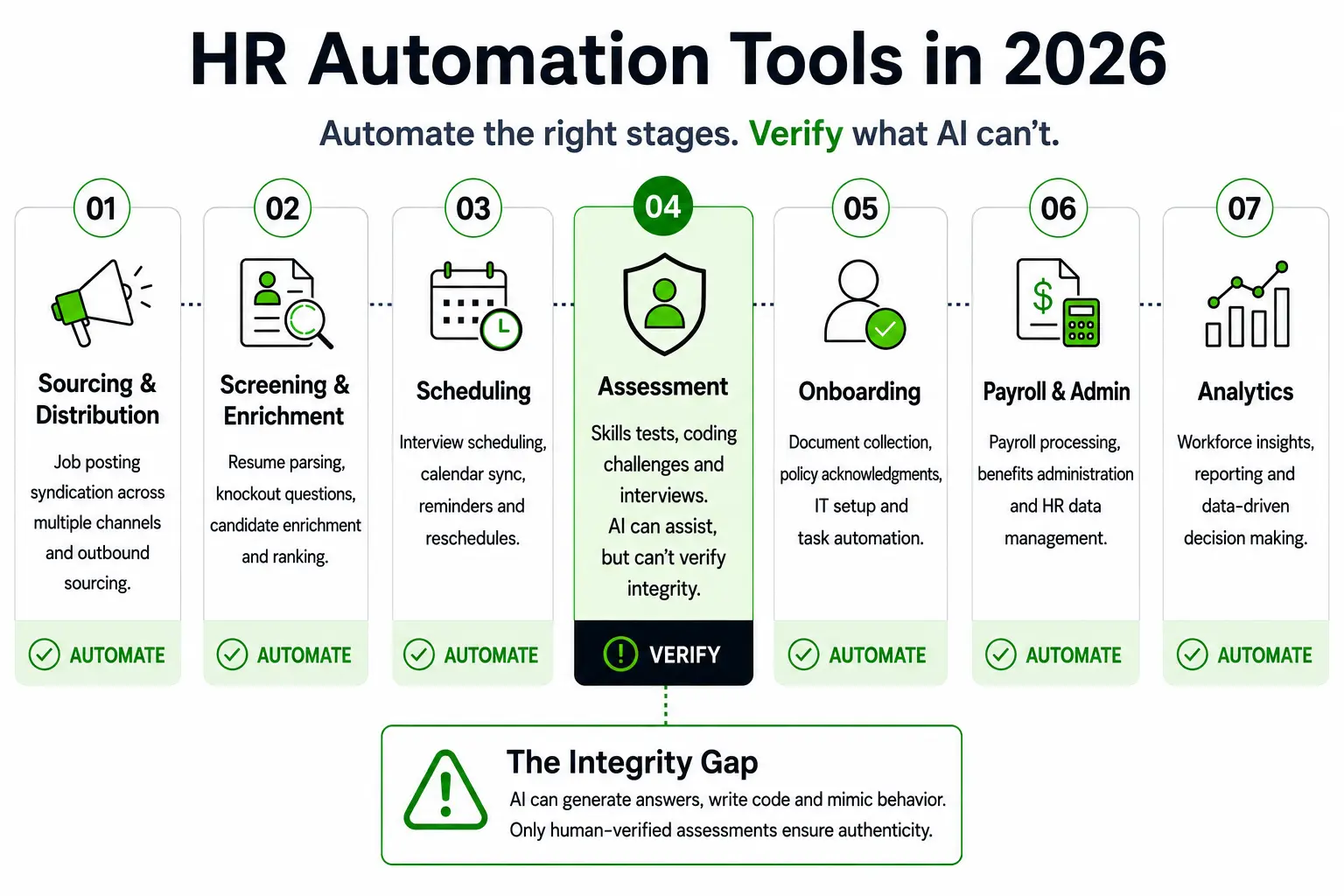
This guide is for the person deciding what to buy. It covers what HR automation means now that software executes workflows instead of suggesting them, the seven layers of the stack and which are mature, the integrity gap that opened when generative AI reached candidates, how to score a vendor without sitting through four demos, and a ninety day rollout that survives a real team.
What HR automation actually means in 2026
HR automation is the use of software to execute human resources processes, from job posting through onboarding and payroll, without a person clicking through every step. That definition has held for a decade. What changed is who executes.
Until recently, most HR process automation tools were assistive. They drafted the offer letter and waited. They flagged the incomplete onboarding checklist and waited. A human moved every piece. In 2026 the category shifted toward agentic systems that carry a multi step task from trigger to completion, checking in only at defined decision points.
The adoption data shows that shift more clearly than any vendor roadmap. ADP reports agentic AI already in production at 48 percent of large businesses, 25 percent of midsized businesses and 4 percent of small ones, with CHROs projecting 327 percent growth in agent adoption by 2027. Gartner expects 33 percent of enterprise software applications to include agentic AI by 2028, up from under 1 percent in 2024. On the HR side specifically, SHRM data puts automation adoption growth at 599 percent over two years, with 42 percent of HR professionals planning further expansion inside five years.
The consequence is that buying decisions got heavier. When software only suggested, a bad tool wasted time. When software executes, a bad tool makes decisions you have to defend.
HR automation tools, HR automation software and HRIS are three different things
Vendor copy uses these interchangeably and it should not. An HRIS or HCM is a system of record holding employee data. Human resources workflow software is an execution layer that runs sequential or branching tasks across systems you already own. HR automation tools is the broader category covering both.
Most teams already own a system of record. What they are shopping for is the execution layer, and the best tools for automating HR workflows in HCM environments sit on top of it rather than replacing it.
The seven layers of the HR automation stack
Vendor listicles compare products, which is the wrong unit of analysis, because a product that is excellent at one layer can be useless at the next. Map your stack in layers first, then shop each layer on its own merits.
Sourcing and distribution. Job posting syndication across paid boards, free job boards and your careers page, plus outbound sourcing. Mature and largely commoditised. This is where talent attraction and recruitment marketing budgets get spent, and manual headhunting still beats automation for genuinely scarce roles.
Screening and enrichment. Resume parsing, knockout questions, candidate enrichment against public data, and ranking. Also mature, and under the most regulatory scrutiny. Recruiting software and applicant tracking systems both live here.
Scheduling. Availability matching, calendar coordination across panels and time zones, reminders, and rescheduling. The highest return, lowest risk automation in the stack. Nobody built a competitive advantage on manual scheduling coordination, and Gartner ranks workflow automation among HR leaders' top three priorities for 2026. If you automate one thing this quarter, automate interview scheduling.
Assessment. Structured interviews, video and language based evaluation, work samples, and scoring. The least mature of the seven, and the next section explains why that matters more now than in 2024.
Onboarding. Document collection, account provisioning, equipment requests, policy acknowledgements, and first week scheduling. Employee onboarding automation touches HR, IT, finance and the hiring manager on day one, which is why it breaks so often and repays automation so well.
Payroll and administration. Payroll runs, leave and attendance, benefits enrollment, and statutory filing. Well served by incumbents, heavily jurisdiction specific, and rarely worth replacing unless something is broken.
Analytics. Funnel reporting, quality of hire, cost per hire, and workforce planning. Insight222 found 68 percent of organisations increased analytics investment this year. This layer only pays off if the six beneath it emit clean data, so it is the last to build and the first people try to buy.
Six of those seven layers have credible, boring, working solutions. The seventh does not, and it decides whether everything upstream produced anything real.
The layer nobody automated, interview integrity
Here is the number that should reframe your buying priorities. Across 19,368 AI led interviews analysed between July 2025 and January 2026, Fabric found 38.5 percent triggered cheating flags. The rate climbed from 9 percent in July 2025 to 45 percent by September and stayed there.
This is not confined to technical hiring. A 2026 Resume Genius survey of 1,000 US job seekers found 22 percent already use AI during live interviews, not only to prepare for them, and CodeSignal reported cheating on coding assessments roughly doubling between 2024 and 2025. Roughly 65 percent of hiring managers now say they are worried about generative AI in recruitment assessments.
Two distinct problems get collapsed into one here, and they need different controls.
Identity fraud is somebody other than the candidate doing the interview. Gartner's 2Q25 survey of 3,000 job seekers found 6 percent admitted to interview fraud, and Gartner projects one in four candidate profiles worldwide will be fake by 2028. You solve this at the door, with identity verification and liveness detection.
Content cheating is the real candidate giving answers generated by a model in real time, through a hidden earpiece, a phone off camera, or an overlay the screen share cannot see. That cannot be solved at the door. It has to be handled throughout the conversation.
Most published advice on detecting content cheating is two years out of date. These signals stopped working:
- Eye movement tracking, because candidates now sit a second screen just below the camera line
- Tab switching, because dedicated overlays render outside the browser entirely
- Answers that sound too polished, which describes a well prepared candidate as often as a coached one
- Plagiarism checkers, built for written submissions and poor on conversational transcripts
- Asking candidates not to use AI, which is a request rather than a control
The signals that hold up are quieter. Silence ratio, meaning the pause pattern before answers rather than the pause length. Response latency measured against question complexity. Vocabulary mismatch between spoken answers and the candidate's written samples. Speaker diarisation to catch a second voice. Above all, adaptive follow up questions generated from what the candidate just said, because a model can produce a strong first answer and cannot survive three layers of interrogation about a project it never worked on.
The scale of the gap shows in an interviewing.io experiment where candidates using ChatGPT solved verbatim problems correctly 73 percent of the time and interviewers did not suspect misuse in a single session. Human detection, on its own, has already failed.
There is a cost to overcorrecting, and most vendors will not mention it. Verification that feels like surveillance drives away the senior candidates you most want, because they have options and will not sit through an interrogation. The controls that hold up are the ones a legitimate candidate never notices. Adaptive questioning reads as an interviewer taking genuine interest. A proctoring tool demanding screen recording and webcam access reads as distrust before the conversation starts. Build the invisible controls first and reserve the intrusive ones for roles where the risk actually justifies them.
This is the layer Gezora.ai was built for. The HR Automation platform handles interview scheduling and conducting, runs video and language based assessment, and produces an authenticity signal on whether a candidate is answering with a generative model.
How to evaluate HR automation software without buying a demo
Score every vendor on the same eight criteria before anyone books a call. Weight them for your situation, then let the numbers argue. This is how you compare HR automation tools without a demo deciding for you.
| Criterion | What to actually ask | Red flag |
|---|---|---|
| Integration depth | Which systems does it write to, not just read from? | Read only access to your HRIS |
| Workflow branching | Can a workflow take different paths based on conditions? | Linear sequences only |
| Human override | Can a person reverse any automated decision, and is it logged? | Override requires vendor support |
| Audit logging | Is every automated decision retrievable with its inputs? | Logs retained under 12 months |
| Data residency | Where is candidate data stored and processed? | No answer, or one region only |
| Pricing model | Per employee, per hire, or platform licence? | Pricing that scales with volume you cannot forecast |
| Implementation load | How many of your hours, realistically, in the first 90 days? | "Live in a day" |
| Integrity controls | How does it verify the assessment output is the candidate's own work? | The question is treated as unusual |
Integration depth and implementation load are where most disappointment starts. The licence is rarely the expensive part.
One habit is worth building before you sign anything. Ask each vendor for two references who churned, not two who renewed. Most will refuse, and the refusal is itself information. The ones who agree will tell you where the product breaks under conditions that resemble yours, which no demo environment will ever show you.
Sizing the stack for a small business
If you hire under 100 people a year, you do not need seven layers. You need scheduling, assessment and onboarding, connected to whatever record system you already run. The market for the best ATS for small business is competitive and priced accordingly, which is why the best applicant tracking systems for small businesses carry some of the highest advertising costs in HR technology. Buy the layer costing you the most hours, prove it works, and leave the rest until the pain is real.
A ninety day rollout that does not collapse in week three
The teams that get value from HR workflow automation treat it as a pilot, not a migration.
Days 1 to 30, baseline. Pick one high volume workflow. Scheduling is usually right because it is measurable and low risk. Record what it costs you today in hours, in time to hire, and in candidate drop off. Without that number the project gets judged on vibes.
Days 31 to 60, pilot. Run the workflow on a real requisition with a human override on every automated decision. Expect the first two weeks to be worse than manual. That is normal. Log every exception, because exceptions are your configuration backlog.
Days 61 to 90, measure and decide. Compare against the baseline on cost per hire and time to hire, then expand to the next workflow or retire this one. Retiring a failed pilot is a legitimate result, and teams who treat it as failure carry dead HR automation tools for years.
Measure four things during the pilot and ignore the rest. Hours returned to the team, which is the number that funds the next phase. Time to hire against your baseline. Candidate drop off at the automated step, because a workflow that saves your team time by losing applicants is not a win. And exception rate, which tells you whether the automation is running or quietly handing everything back to a human.
What should not be automated
Some decisions should stay slow and human. Termination conversations. Grievance and investigation handling. Final hiring decisions, as opposed to shortlisting. Accommodation requests. Anything requiring judgment about a person's circumstances rather than a rule applied consistently. Automating these saves little time and creates exposure that dwarfs the saving.
Compliance is a build requirement now
Under Annex III of the EU AI Act, AI used for recruitment, candidate selection, interview analysis and workplace decisions is high risk. The obligations fall on deployers as well as providers, so the company using the tool shares liability with the company that built it.
The timeline moved. The Council of the EU approved the Digital Omnibus on 29 June 2026, deferring the high risk compliance deadline from 2 August 2026 to 2 December 2027. Penalties are unchanged at up to 15 million euro or 3 percent of global turnover.
One prohibition was not deferred and has applied since 2 February 2025. Emotion recognition in the workplace is banned outright, along with biometric categorisation of protected traits. That gives you a clean vendor test. If a sales deck offers to read a candidate's tone, facial cues or emotional state, that is a prohibited practice in the EU. End the conversation.
The rest is unglamorous and portable across jurisdictions. Keep an audit log of automated decisions, run bias testing on screening criteria, confirm every criterion is a bona fide occupational qualification you could defend, tell candidates when AI is used, and know where their data sits and how long you keep it. Vendor due diligence deserves its own checklist, and it is worth building before you sign anything, not after.
Where to start
The argument here fits in a sentence. Automate the layers that are repeatable and verify the ones that are not.
Scheduling, onboarding and administration are solved problems, and the HR automation tools that handle them are mature enough that choosing between them is a procurement exercise. Assessment is different. Throughput without verification is a faster route to the same bad hire, and the data says that route gets busier every quarter.
To see what interview integrity looks like when it is built into the workflow rather than bolted on afterwards, get started with Gezora.ai.
Topics
- HR automation tools
- Agentic AI in HR
- AI interview integrity
- Recruiting technology
- EU AI Act compliance
- Hiring automation
- HR workflow automation
Frequently asked questions

Get started
Stop paying people to do what an agent can
Tell us what you want to automate. We will map the workflow, deploy the right agents, and train your team to run them.
- Every agent is trained on your own workflows, never a generic template
- Most deployments are live within two to four weeks
- SOC 2 compliant, with a complete audit trail on every deployment