One Way Video Interviews in 2026: How They Work, Where They Break, and How to Fix Them
How one way video interviews work, why hiring teams adopted them, the two failures that hit them in 2026, and how to design one candidates finish.
Sufi Inam Ul Hassan
AI Engineer10 minute read
"A one way interview is not a conversation moved online. It is a written application with a camera attached, and every strength and failure of the format follows from that one fact."
A one way video interview solves a real problem. Your team cannot run 200 phone screens a month, so you send candidates a set of questions, they record answers on their own time, and your recruiters watch at double speed. Screening capacity stops being limited by calendar slots.
That trade held cleanly for about five years. In 2026 it stopped holding, for two reasons that arrived at the same time. Candidates started answering recorded questions with a language model open on a second screen, and the format cannot see it happening. Meanwhile the volume that made asynchronous screening necessary in the first place got worse, so teams responded by sending longer interviews, and completion rates fell.
This guide covers what a one way video interview actually is, how the workflow runs end to end, why teams adopted it, the two places it now breaks, and how to design one that candidates finish and that produces a score you can defend.
What is a one way video interview?
A one way video interview is a screening format where the candidate records video answers to a fixed set of questions with no interviewer present, and the hiring team reviews the recordings later. It is also sold as an asynchronous video interview, a pre recorded video interview, or an on demand video interview. Those are the same product under four names.
The defining property is the absence of a live counterpart. Nobody asks a follow up. Nobody notices a pause. Nobody adapts the next question based on the last answer. Every advantage and every failure of the format traces back to that single fact.
That also explains why the category has so many names. Vendors have spent years trying to find a label that sounds less transactional than what the format actually is, which is why you will see the same product sold as on demand screening, video screening and asynchronous assessment depending on who is pitching.
One way versus live video interview
A live video interview is a normal interview held over video. Both people are present, the conversation adapts, and it consumes a calendar slot from each side. The asynchronous version consumes no interviewer time at the point of recording, which is the whole reason it exists.
The useful way to think about it is that a live video interview is a conversation moved online, while a one way interview is a written application with a camera attached. That reframing matters more than it sounds, because most teams design their one way interviews as though they were conversations, and then wonder why the answers feel flat.
How the workflow runs, end to end
An asynchronous video interview follows the same six stages at every vendor, and the differences between platforms sit in the details of each one.
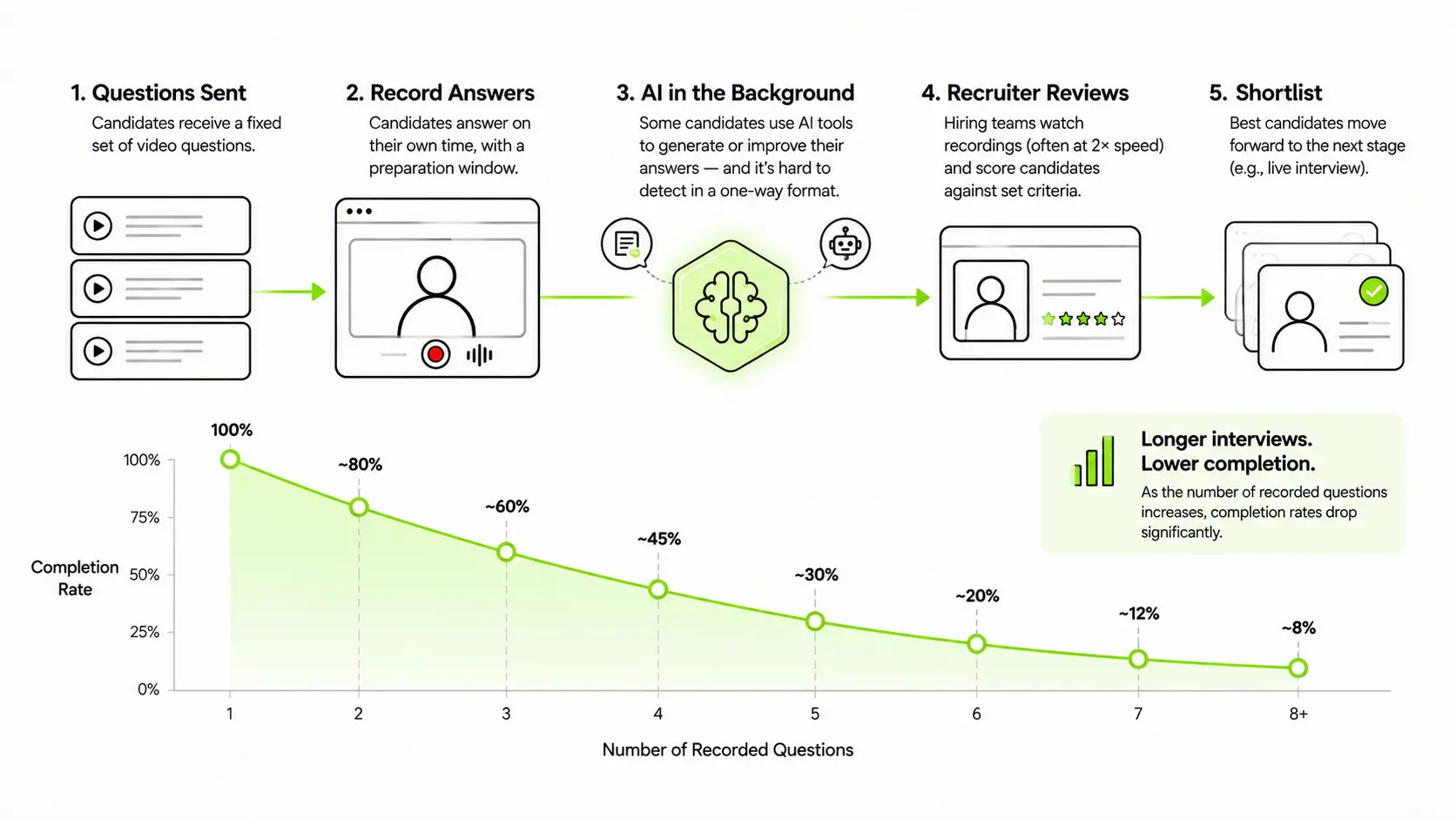
Question set. You write between three and eight questions for the recorded video interview. Some platforms let you record them as video, others present them as text. Video framing lifts completion rates but locks the question set, since re recording is a job nobody wants to repeat.
Invitation and deadline. The candidate receives a link with an expiry, typically three to seven days. Shorter deadlines raise urgency and lower completion. Longer deadlines do the reverse.
Preparation window. The candidate sees each question, gets a defined amount of thinking time, then recording begins automatically. Thinking time is the single most consequential setting on the whole platform, and section five explains why.
Recording and retakes. The candidate records within a time limit, usually 60 to 180 seconds. Retake policy is your call. Unlimited retakes produce polished answers that tell you little. Zero retakes punish nervous candidates and bad wifi rather than weak ones. One retake is the setting most teams land on.
Review and scoring. Recruiters watch, often at increased speed, and score against a rubric. This is where most of the reclaimed time goes back out the door if the rubric is vague.
Decision and feedback. Advance, reject, or route to a live round. The feedback step gets skipped constantly, and it is the main reason candidates resent the format.
Why hiring teams adopted asynchronous screening
The adoption case is arithmetic, and the arithmetic got dramatic. Greenhouse data covering more than 640 million applications across over 6,000 companies puts applications at 244 per open role in 2025, up from 116 the year before, while recruiters per organisation fell from 10.43 to 4.62. Applications roughly doubled while the team reviewing them roughly halved.
The pressure is not evenly distributed either. A Robert Walters survey found 70 percent of Middle East employers have seen a surge in job applications driven by AI tools, which makes the squeeze sharper in the Gulf than the global averages suggest. A Robert Half survey from March 2026 found 67 percent of US HR leaders say reviewing AI generated applications has slowed their hiring, with one in five reporting delays beyond two weeks, and 84 percent reporting heavier workloads.
Against that, the format delivers three things a phone screen cannot. It removes scheduling entirely, which for high volume roles is the largest single time cost in early stage hiring. It lets every candidate answer the same questions in the same order, which makes comparison meaningful and gives you something defensible if a rejection is ever challenged. And it lets a candidate in a different time zone complete a screen at midnight without a recruiter losing an evening.
The standardisation point is underrated. A phone screen varies with the recruiter's mood, the time of day and how many they have already done that week. Two candidates screened by two recruiters on a Friday afternoon are not being compared on the same basis, and nobody can prove otherwise afterwards because no record exists. A recorded screen produces an artefact you can go back to, which matters both for calibration and for the moment somebody asks why a particular candidate was rejected.
None of that has stopped being true. What changed is that the format acquired two failure modes that did not exist when teams adopted it.
Where one way interviews break in 2026
The first failure is that the format cannot tell whether the candidate wrote the answer.
A pre recorded video interview is the easiest possible environment in which to use a language model. The candidate can see the question, has thinking time before recording starts, and faces no interviewer who might follow up. Across 19,368 AI led interviews analysed between July 2025 and January 2026, Fabric found 38.5 percent triggered cheating flags, with the rate climbing from 9 percent in July 2025 to 45 percent by September.
Human review does not catch it. In an interviewing.io experiment, candidates using ChatGPT solved verbatim problems correctly 73 percent of the time and interviewers did not suspect misuse in a single session. If a live interviewer misses it, a recruiter watching a recording at 1.5x speed has no chance.
The controls most platforms advertise were built for a different threat. Eye movement tracking fails because candidates position a second screen just below the camera line. Tab switching detection fails because overlay tools render outside the browser. Judging an answer as too polished fails because that describes a well prepared candidate as often as a coached one.
What still works is quieter. Silence ratio, meaning the pause pattern before an answer rather than its length. Response latency measured against question complexity. Vocabulary mismatch between spoken answers and the candidate's written application. Above all, adaptive follow up questions generated from what the candidate just said, because a model produces a strong first answer and cannot survive three layers of specific interrogation about a project it never worked on. That last control is the one a pure one way format structurally cannot offer, which is why the strongest platforms have quietly stopped being purely one way.
The second failure is that longer interviews do not get finished.
The intuitive response to noisier applicant pools is to screen harder, so teams add questions. Every question added is another point at which a candidate with three other applications open decides this one is not worth the effort. The candidates most likely to abandon are the ones with options, which means a longer interview systematically filters out your strongest applicants while retaining your most desperate ones. That is the opposite of screening.
The effect compounds badly with the reputation problem. Recording video into a system that never replies is a distinctive kind of unpleasant, and candidates talk about it publicly in a way they never did about unanswered phone screens. A team that lengthens its interview and skips its rejection emails will find the completion rate falling for reasons that have nothing to do with the current requisition.
There is a third risk worth naming because it is now a legal one. Emotion recognition in the workplace has been prohibited in the EU since 2 February 2025, along with biometric categorisation of protected traits, and that prohibition was not deferred when the rest of the AI Act high risk timeline moved to 2 December 2027. Several video interview vendors historically scored facial expression, tone and enthusiasm. If a platform still offers that, it is a prohibited practice rather than a feature.
How to design one that works
Cap the interview at four questions. Three is better. You are running a screen, not an assessment. If four questions cannot tell you whether someone is worth 30 minutes of a hiring manager's time, the problem is the questions.
Set thinking time to 30 seconds or less. This is the setting that matters most and almost nobody tunes it. Long preparation windows are what make the format trivially easy to answer with a model. A 30 second window is enough for a prepared human to collect a thought and not enough to prompt, read and rehearse. Some teams drop to 15 seconds for senior roles specifically, on the reasoning that a candidate who has genuinely done the work does not need longer.
Ask questions a model cannot answer. Generic behavioural prompts like tell us about a time you showed leadership are exactly what language models are best at. Ask instead for a specific decision the candidate personally made, a number they personally owned, or a tradeoff they personally lost. What did you cut from the last project you shipped, and what broke as a result, produces an answer that is either concrete or obviously hollow.
Write the rubric before you send the invitation. Three scoring levels per question with a written description of what each looks like. Without this, review time balloons and two recruiters score the same answer differently, which destroys the comparability that justified the format.
Allow exactly one retake and say so up front. It removes the wifi excuse without producing rehearsed performances.
Send a decision to everyone within five business days. Candidates tolerate asynchronous screening. They do not tolerate recording video into a void and hearing nothing. This is the cheapest reputation protection available to you.
Choosing video interview software
Score every platform on the same eight criteria before booking a demo, and weight them for your own situation.
| Criterion | What to ask | Red flag |
|---|---|---|
| Integrity signals | How do you detect a model assisted answer? | Eye tracking or tab detection only |
| Adaptive follow ups | Can it ask an unscripted question based on the answer? | Fixed question sets only |
| Thinking time control | Can I set it per question, down to 15 seconds? | Fixed or vendor controlled |
| Completion analytics | Do you report drop off by question number? | Not measured |
| Language coverage | Can candidates answer in a second language and be scored fairly? | English only |
| ATS integration | Does it write results back, not just read? | Read only or manual export |
| Data residency | Where is candidate video stored and for how long? | No answer, or one region only |
| Emotion scoring | Do you score facial expression or tone? | Any answer other than a clear no |
That last row is a filter, not a preference. A vendor still selling emotion analysis in 2026 has either not read the regulation or is betting you have not. Ask the question in writing and keep the answer, because under the AI Act the deployer carries liability alongside the provider, and your procurement file is what demonstrates you asked.
The two criteria that separate platforms in practice are adaptive follow ups and completion analytics. Follow ups are the only detection control that survives a determined candidate, and drop off data by question number is the only way to learn that your six question interview is losing 40 percent of applicants at question five. Most vendors do not report it, because it is not flattering. Gezora.ai handles interview scheduling and conducting, runs video and language based assessment, and returns an authenticity signal on whether a candidate is answering with a generative model.
Where to start
The one way video interview is still the right answer to a real problem. Applications doubled, recruiting teams halved, and no amount of process discipline closes that gap on its own.
What has changed is that the format now needs designing rather than just switching on. Cut it to four questions, drop thinking time to 30 seconds, ask questions that require a specific memory rather than a general opinion, and pick a platform that can ask an unscripted follow up. Those four changes cost nothing and fix most of what has gone wrong.
If you want to see how adaptive follow ups and authenticity signals work inside a real screen, get started with Gezora.ai.
Topics
- One way video interview
- Video interview software
- Asynchronous screening
- AI interview integrity
- Recruiting technology
- Hiring automation
Frequently asked questions

Get started
Stop paying people to do what an agent can
Tell us what you want to automate. We will map the workflow, deploy the right agents, and train your team to run them.
- Every agent is trained on your own workflows, never a generic template
- Most deployments are live within two to four weeks
- SOC 2 compliant, with a complete audit trail on every deployment